Build your strength training plan in six steps
Start with the week you actually have. If you can usually train twice, make those sessions workable before adding a fourth training day.
| Step | What to decide |
|---|---|
| 1. Define your goal | For example, getting stronger, building muscle or establishing a routine. Use a main goal to guide your decisions. |
| 2. Choose realistic days | Schedule regular sessions and account for work, other sports and travel. |
| 3. Select suitable exercises | Cover your upper and lower body with pushing, pulling, a knee-dominant movement, a hip-dominant movement and trunk control. |
| 4. Set the training dose | Record working sets, repetitions, load or perceived effort, and rest. Count warm-up sets separately. |
| 5. Agree how to progress | Decide when to add repetitions, load or, where appropriate, sets. |
| 6. Review the plan | Look at your logbook, technique and recovery. Change one relevant factor at a time. |
The 2026 ACSM position stand supports regular, progressive resistance training. Your goal determines which training variables you emphasise; a complicated programme is not a requirement for getting started. [1]
Training volume and frequency: what is the difference?
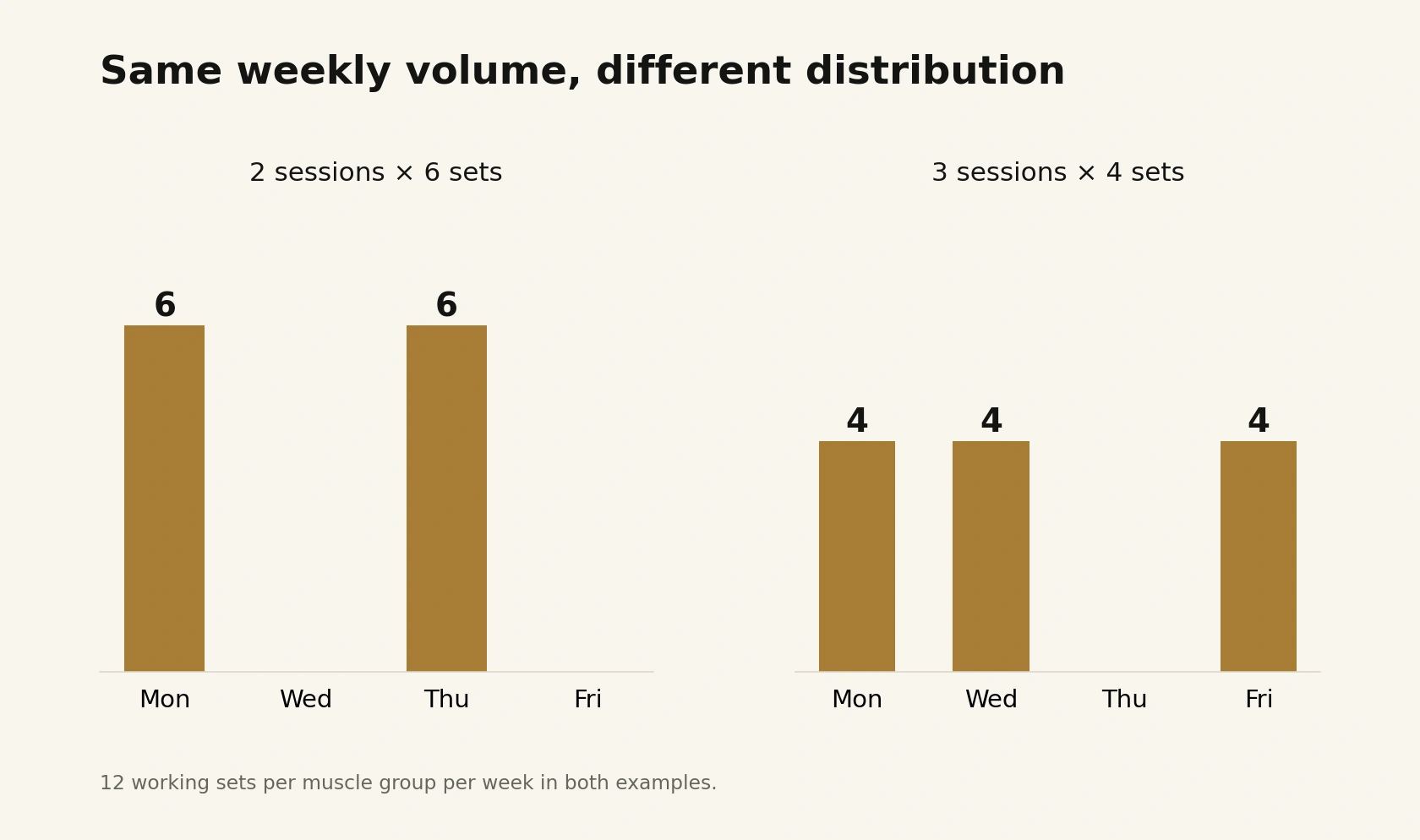
Here, training volume means the number of working sets per muscle group per week. Muscle-group frequency means how often you train that muscle group in the week. This differs from the total number of times you visit the gym.
For example, twelve working sets for a muscle group can be spread over two sessions of six sets or three sessions of four sets. Weekly volume remains twelve; its distribution changes.
A recent meta-regression found associations between greater weekly volume and greater training adaptations, with diminishing returns. Higher frequency showed a clearer association with strength than with muscle growth. These findings do not identify an exact personal optimum. [3]
How many sets do you need?
Start with an amount you can perform with control and repeat consistently. The example below generally uses two working sets per exercise. This is a practical introduction rather than a proven optimal dose for everyone.
Do not increase volume simply because an online list gives a higher number. First check whether you complete your existing work regularly, find it challenging enough and recover from it. Adding work later may suit a more specific muscle-building goal.
Account for overlap, too: your triceps contribute to a bench press, but a bench press set is not automatically equivalent to a dedicated triceps set. Consider direct and indirect work rather than adding everything together indiscriminately. [3]
Choosing sets, repetitions and effort
A prescription of “3 × 10” does not tell you how hard you are training. Ten repetitions with a load you could easily lift twenty times require a different effort from ten repetitions with only two more possible.
For an introductory programme, a useful agreement is to finish sets with an estimated two or three technically similar repetitions left. This is called repetitions in reserve, or RIR. It takes practice to estimate, particularly when you are new to lifting.
A range of 8–12 repetitions is straightforward for many exercises, but it is not a magical muscle-building zone. Heavier loads may play a greater role when maximal strength is the specific goal. You do not need to test your maximum without preparation. [1]
Choose exercises you can control and that support your goal. Machines, dumbbells and barbells can all have a place in your programme.
Volume versus intensity: compare the same variables
Intensity sometimes means the load used, for example as a percentage of your maximum. In another discussion it may mean how hard a set feels. Agree which meaning you are using.
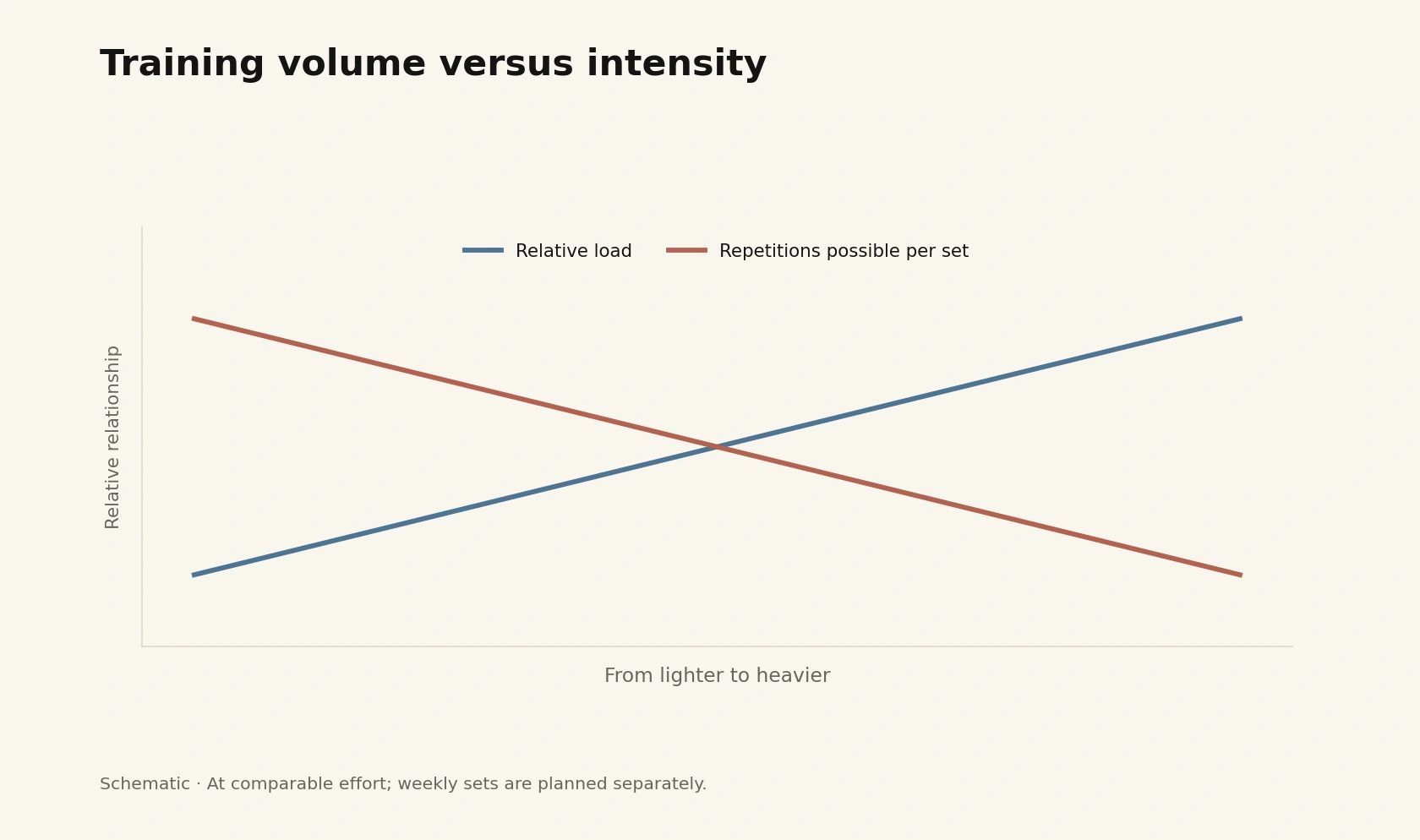
For the same exercise at comparable effort, a heavier load generally allows fewer repetitions per set. The image illustrates that relationship. It does not mean that a heavier programme automatically contains fewer working sets per week: load, repetitions and weekly sets are separate decisions.
How long should you rest between sets?
Rest long enough to complete the next set with the intended technique and effort. A heavy squat may require more recovery than a lighter arm or trunk exercise.
| Situation | Practical starting point |
|---|---|
| Demanding compound exercise | Around 2–3 minutes; longer if needed to perform the next set well. |
| Smaller or less demanding exercise | Around 1–2 minutes, adjusted to performance and breathing. |
| Specifically heavy strength sets | Sometimes 3–5 minutes. The task determines the rest you need. |
| Circuit or superset | Consider the rest before the same exercise and the work you do in between. |
These are practical starting points. A 2024 review suggests a small muscle-growth benefit from resting longer than sixty seconds, but does not establish one ideal rest duration for everyone. [2]
Do not chase shorter breaks if you consistently lose substantial repetitions or control. A temporary growth-hormone rise after short rests is not evidence that the approach produces more muscle growth. [5]
Why fatigue can hide your progress
You can become stronger yet feel less capable during a particular session. Fatigue from previous sets, an earlier workout or a demanding day can affect performance. One disappointing session tells you little about your whole programme.
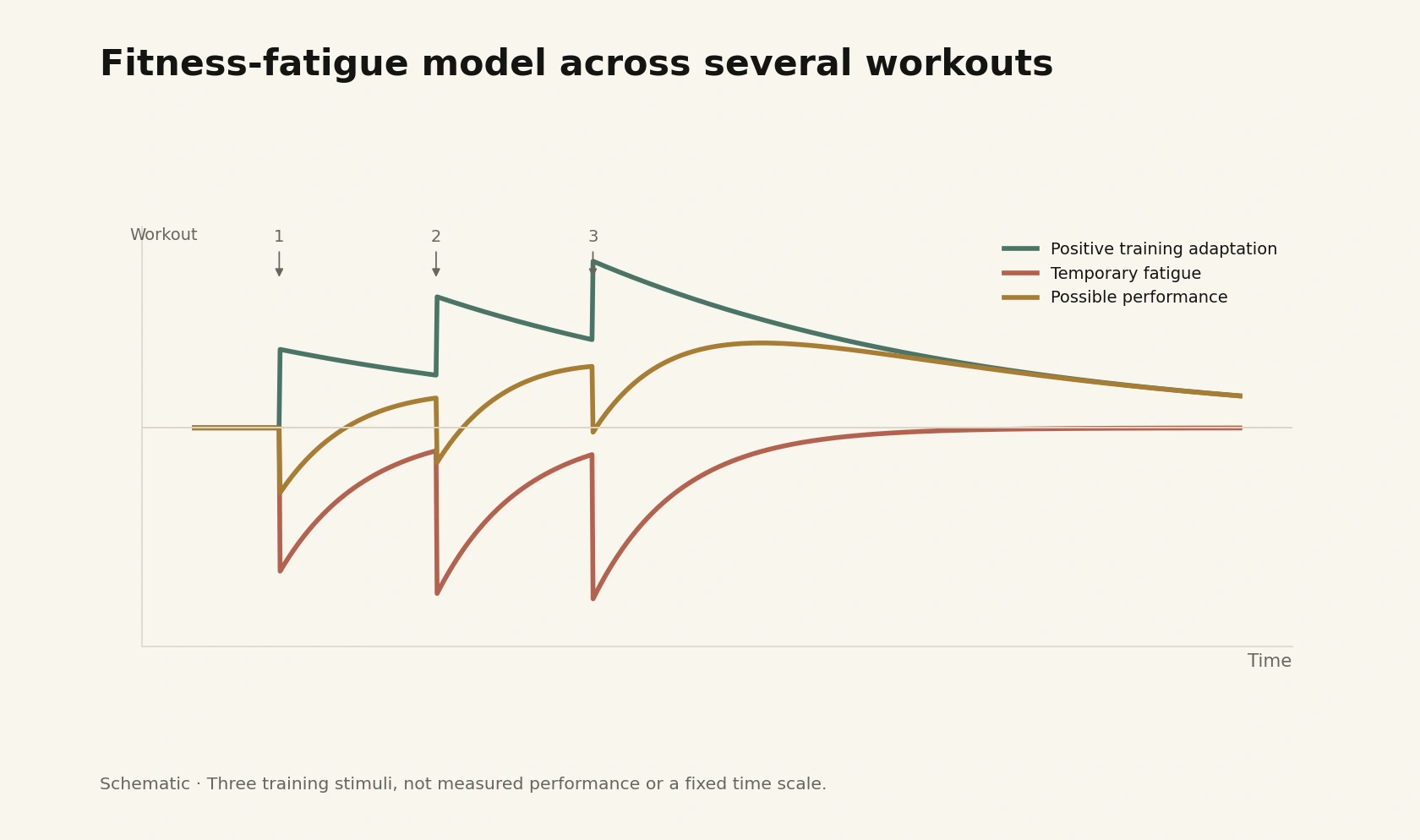
The fitness-fatigue model helps explain this: training may produce both a positive adaptation and temporary fatigue. What you can demonstrate at a given moment reflects both. It is a conceptual model, not a calculation that predicts your exact performance.
Recovery capacity rather than an exact energy meter
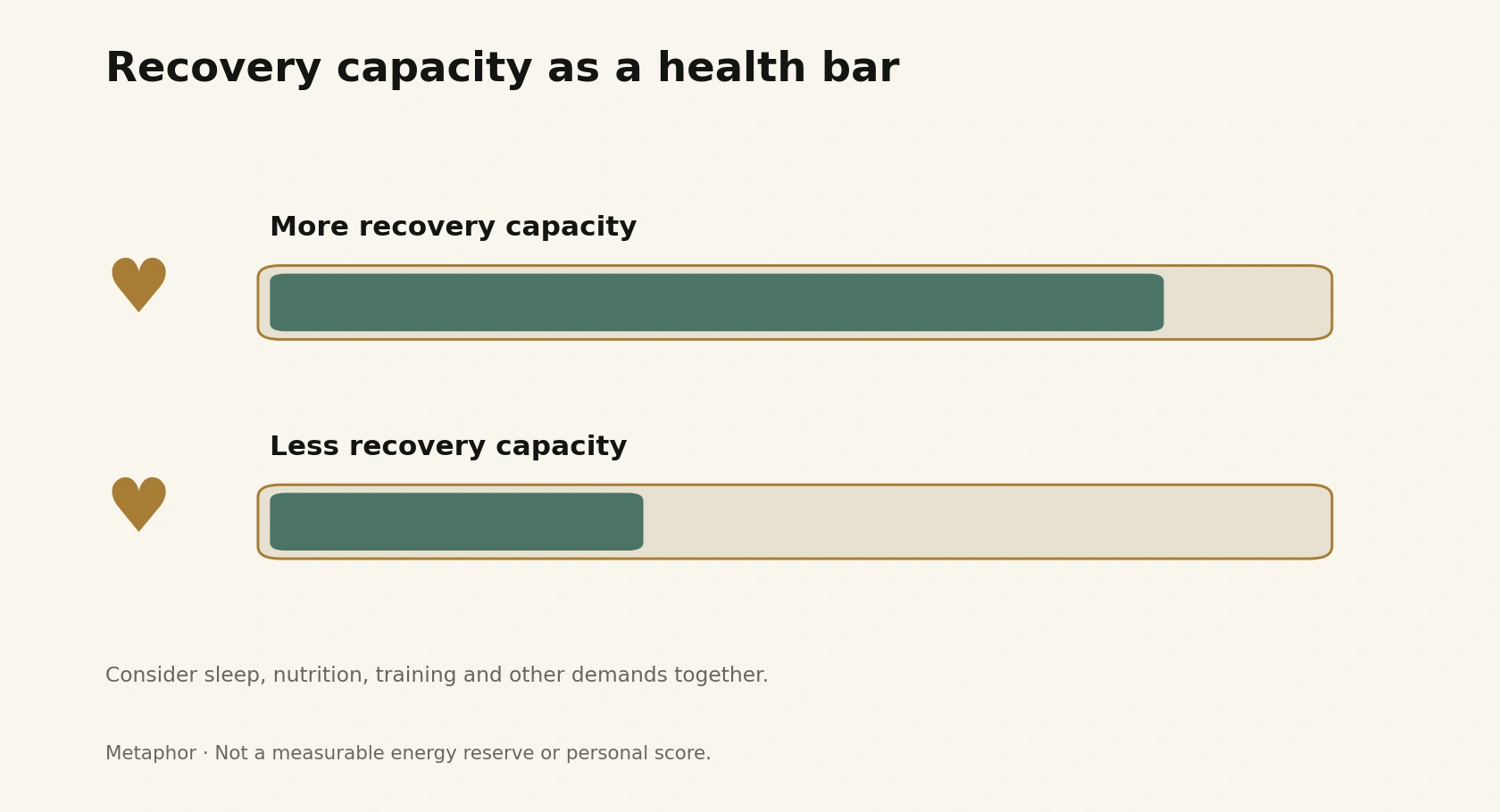
You can compare your recovery capacity to a health bar in a video game. As a metaphor, it can help you discuss your overall workload. You cannot literally measure such a personal recovery reserve or assign every stressor a fixed number of points.
Instead, consider concrete observations: how does the warm-up feel, is technique controlled, and can you repeat your normal training work across several sessions? Include sleep, nutrition, work demands and other sports in that conversation.
Fatigue across several workouts
The three arrows represent successive training stimuli. Each stimulus may produce both adaptation and fatigue. The curves illustrate how these effects can overlap within a conceptual model.
Making recovery capacity visible
The health bar below is a metaphor for discussing training demands and recovery. A longer illustrated bar does not represent a measured reserve. Assess recovery through concrete observations and the context of your week.
Supercompensation is an explanation, not a training clock
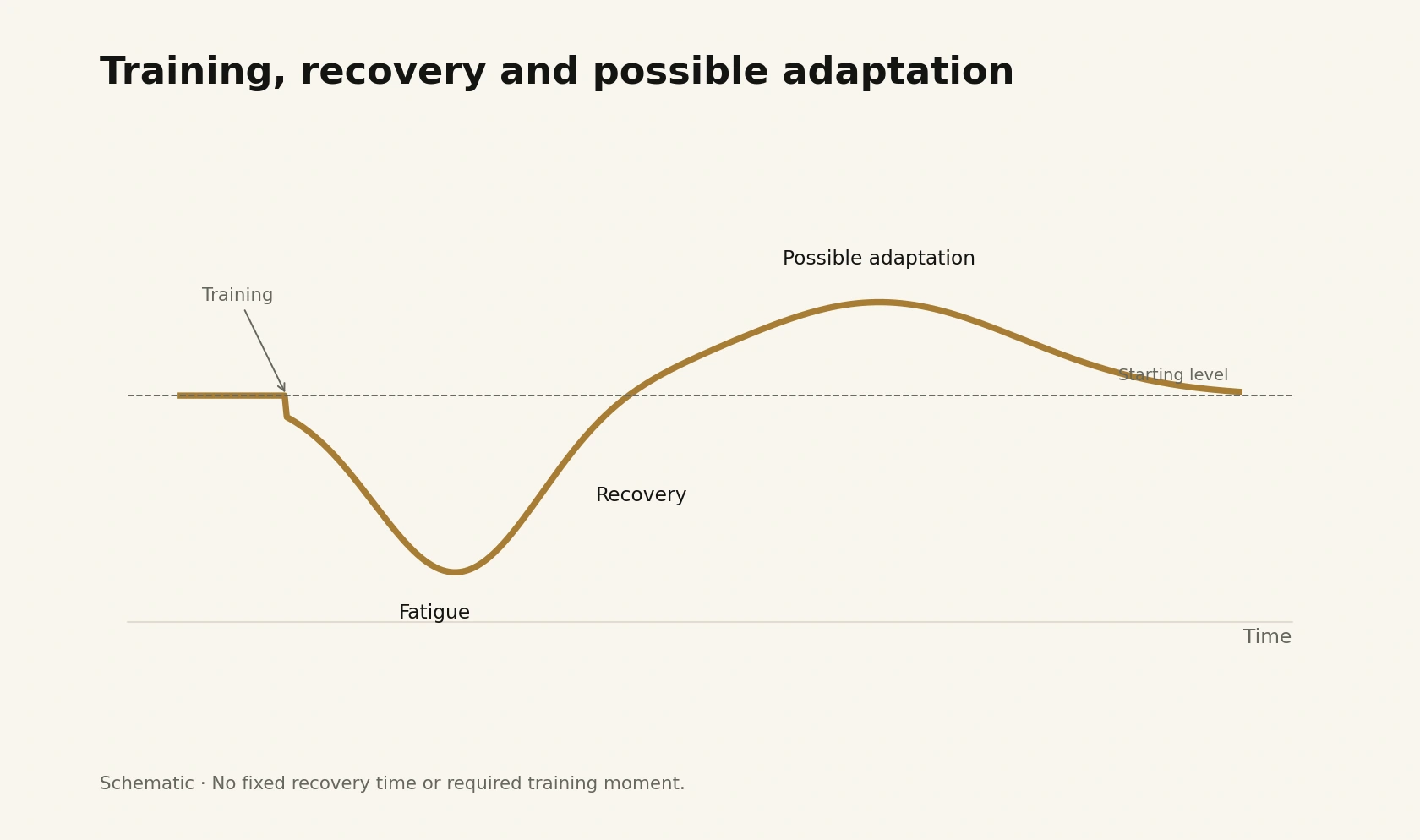
A supercompensation curve schematically shows how a training stimulus may be followed by fatigue, recovery and an improved performance level. The drawing illustrates a principle while simplifying what happens in the body.
Muscles, tendons, skill and general fatigue do not all follow the same timeline. There is no universal moment when you must train again to catch one brief “peak”.
Use a realistic weekly schedule and your training records. A rest day between full-body sessions can be practical. Appropriate spacing also depends on how demanding those sessions are.
Improvement and decline across workouts
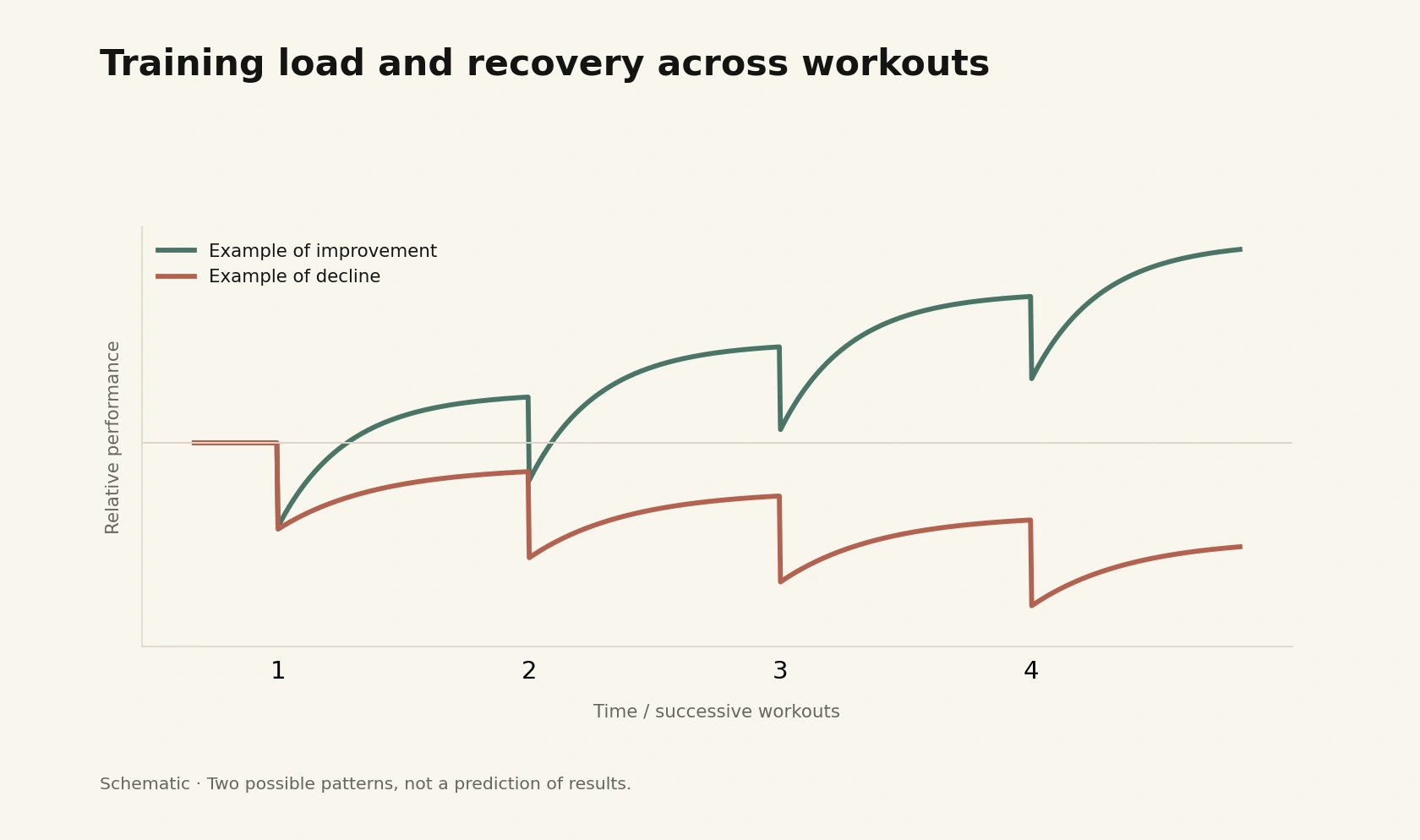
The next image compares two possible patterns across several workouts. The illustrated performance level rises along the green curve, while decline accumulates along the red curve. This explains why you review a series rather than one isolated workout.
Different stimuli, different recovery curves
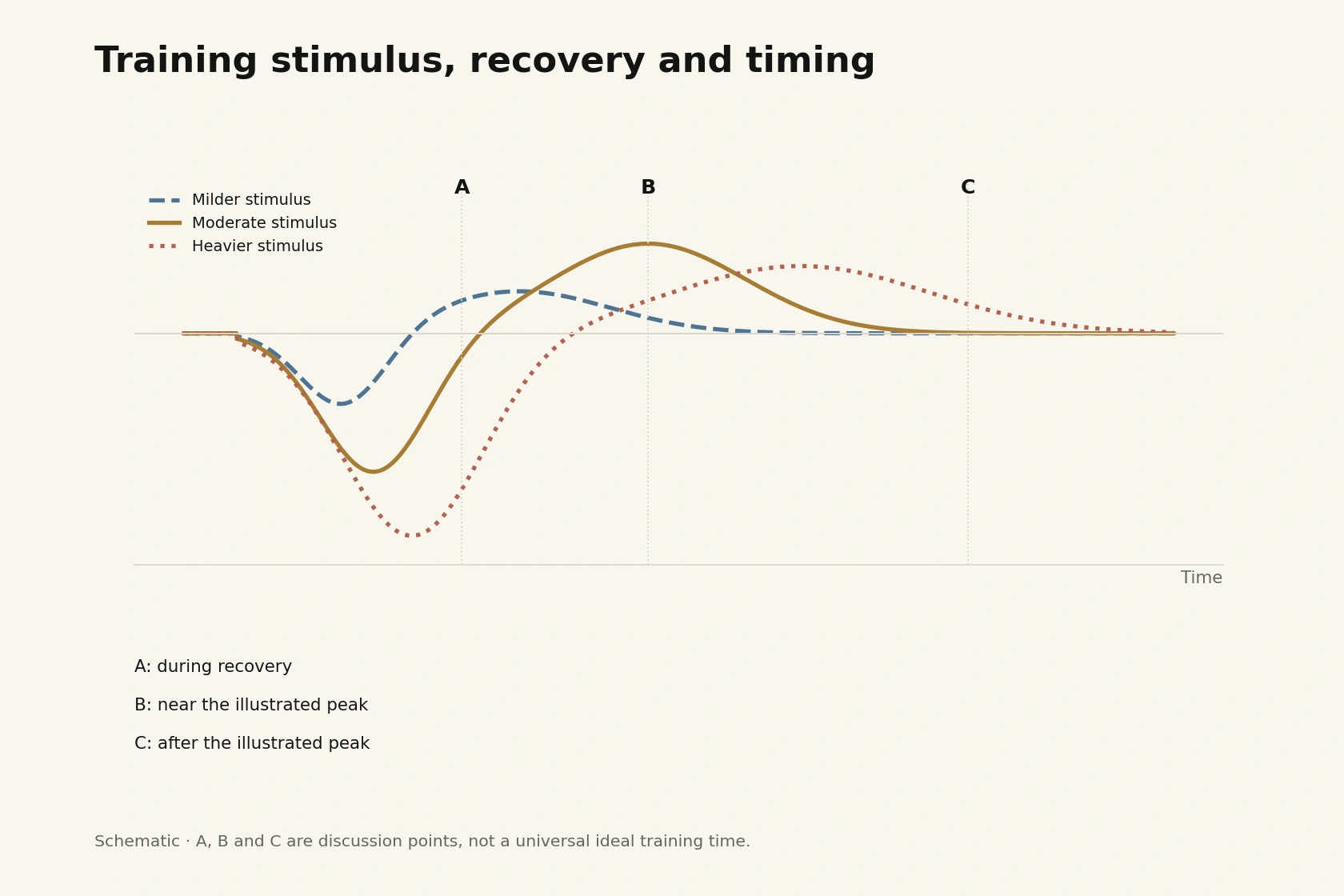
The final diagram develops the idea using three hypothetical stimuli and discussion points A, B and C. A larger stimulus may involve a deeper temporary decline and longer recovery. The model does not give you a personal formula for timing your next workout precisely.
A falls during recovery, B near the illustrated peak and C later along the curve. These letters help explain the drawing. They do not establish that training outside B is ineffective.
Example: a two-day full-body strength training plan
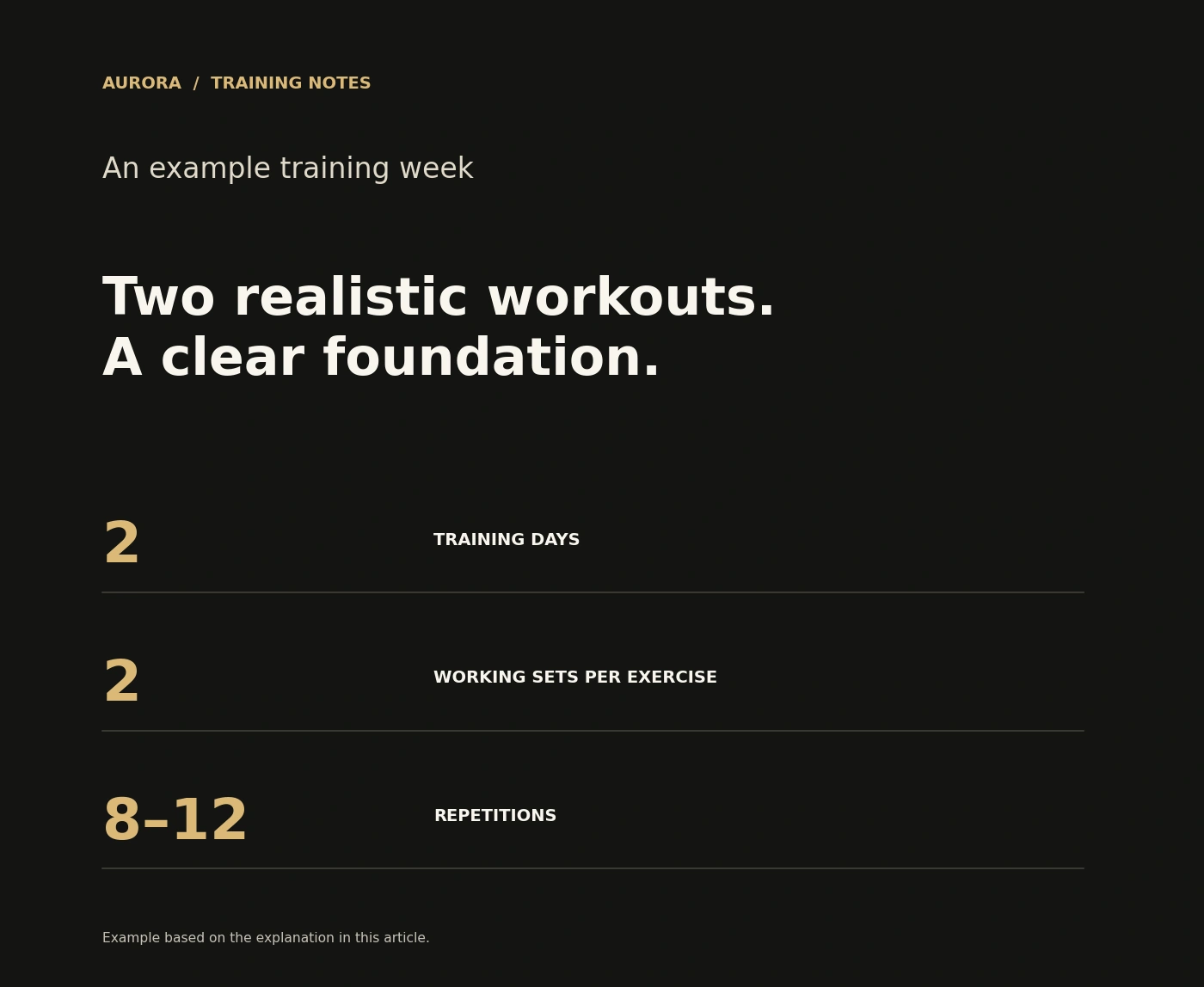
The example below shows how the building blocks fit together. It is a simple starting point for a healthy adult rather than an individual prescription. Choose variations and loads that suit your experience and capacity.
For example, schedule workout A on Monday and workout B on Thursday. Begin with a general warm-up and prepare for the first heavier exercises with lighter practice or warm-up sets. These are separate from the working sets below.
Workout A
| Exercise | Working sets | Repetitions / task |
|---|---|---|
| Goblet squat | 2 | 8–12 |
| Dumbbell bench press or chest press | 2 | 8–12 |
| Cable row | 2 | 8–12 |
| Suitable Romanian deadlift variation | 2 | 8–12 |
| Suitcase carry | 2 | 20–30 seconds per side |
Workout B
| Exercise | Working sets | Repetitions / task |
|---|---|---|
| Split squat, supported if needed | 2 | 8–12 per leg |
| Lat pulldown | 2 | 8–12 |
| Elevated push-up or chest press | 2 | 8–12 |
| Hip thrust or glute bridge | 2 | 8–12 |
| Deadbug | 2 | 6–10 controlled repetitions per side |
For the repetition-based exercises, use the earlier agreement of an estimated two or three repetitions left as a starting point. Rest around two to three minutes for the larger exercises, adjusting this when the next set requires it. Control comes first during carries and deadbugs.
This example does not separately cover every possible specialisation or muscle group. If you want more training days or a different emphasis, read our comparison of full-body and split training.
Progress the plan and make adjustments
Record the load, repetitions in each set, rest and perceived effort for each exercise. With dumbbells, specify whether the weight is per hand. Compare sessions using consistent technique wherever possible.
If you use 8–12 repetitions, build within that range first. Once you repeatedly reach the upper end with control and the agreed effort, try a small increase in load. You do not have to lift heavier every session.
Read the detailed example of progressive overload.
| What do you observe? | Possible next step |
|---|---|
| You are progressing and recovering well | Keep the foundation. Do not change the programme simply for variety. |
| You reach the upper limit with comparable technique | After confirming the performance, try a small load increase. |
| You underperform in one session | Do not force a record. Consider readiness and repeat the same load if appropriate. |
| Several sessions show a clear decline | Review overall workload and recovery. Fewer sets or a lighter week may help. |
| You keep missing the same training day | Make the schedule more realistic before adding volume. |
Pain that increases or changes your movement is not a signal to push through at all costs. Adjust the exercise and seek assessment for persistent symptoms.
Short on time? Separate rest from training density
Training density describes how much work you perform in a given time. Combining exercises and shortening breaks increases density. That can be practical, but may also affect how much weight or how many repetitions you manage per set.
Three minutes between squat sets are not the same as three minutes of complete rest if you spend that time performing a row, press and Romanian deadlift. Other muscles and your breathing are still working.
Pairing two exercises with limited overlap can save time. Check that you still complete the intended training work. More complete rest may be practical when maximal strength is the goal.
If your sessions are consistently short, first decide which exercises contribute most to your goal. Do not automatically squeeze more work into the same number of minutes.
Do you need periodisation?
Periodisation means deliberately organising training variables across periods of time. For example, one block might emphasise learning exercises before a later block places more emphasis on heavier sets.
A 2022 meta-analysis found a maximal-strength advantage for periodisation when volume was equated, but no clear difference in muscle growth. The broader 2026 ACSM synthesis found no consistent general advantage from complex periodisation. Different comparisons and populations therefore require a nuanced interpretation. [1, 4]
For a beginner or busy person returning to training, the first step is usually to follow and track a manageable plan. A specific performance goal may justify more targeted periodisation later.
Plan ahead while allowing for real life. A useful framework helps you decide what to change when work, sleep or recovery differs from what you expected.
Frequently asked questions about strength training plans
How do I make my own strength training plan?
Choose your main goal and realistic training days. Select upper- and lower-body exercises and specify sets, repetitions, effort and rest. Track your results and adapt the plan to your progress and recovery.
Is strength training twice a week enough?
Two sessions can provide a useful foundation for building strength and muscle. Exercise selection, effort, consistency and your goal determine how suitable that is. Two days do not guarantee a particular result.
Should I always do three sets per exercise?
No. The appropriate number depends on the exercise, weekly volume, experience and recovery. Two working sets can be a practical starting point; more is not automatically better.
How long should I rest between strength workouts?
There is no fixed recovery time for every person and muscle. Schedule demanding, overlapping sessions thoughtfully and check whether you can repeat your training work with control.
Should I take every set to muscular failure?
That is not a requirement. In this example, you finish with a few estimated repetitions left. Matching effort to the exercise and goal matters more than always becoming maximally fatigued.
Should I change my training plan every six weeks?
No. Review it regularly, but keep what works. Make changes when your goal, circumstances or results justify them, rather than simply because a date has passed.
Does muscle soreness mean my plan is working?
Soreness alone tells you too little about progress. Also consider technique, consistency and performance over several weeks. You do not need to pursue soreness.
What should I do during a busy or tiring week?
Maintain a realistic part of your routine and adjust sets or load if needed. Do not automatically make up missed workouts in one demanding session.
A strength training plan that fits your week
At Aurora Personal Training in Eindhoven, we turn your goal into a practical programme. We consider your experience, available time, technique and recovery. In the 90 Day Programme, we build your training progressively and use our evaluations to discuss what is working and what needs adjusting.
Sources and evidence
- Currier et al. (2026) — ACSM Position Stand: Resistance Training Prescription for Muscle Function, Hypertrophy, and Physical Performance in Healthy Adults
- Singer et al. (2024) — Give it a rest: inter-set rest interval duration and muscle hypertrophy
- Pelland et al. (2026; online 2025) — The Resistance Training Dose Response: Weekly Volume and Frequency
- Moesgaard et al. (2022) — Effects of Periodization on Strength and Muscle Hypertrophy in Volume-Equated Resistance Training Programs
- West et al. (2010) — Elevations in anabolic hormones enhance neither training-induced muscle hypertrophy nor strength of the elbow flexors