
What does hypertrophy mean?
Hypertrophy means that cells become larger. This article focuses on skeletal muscles: the muscles you use for movement and resistance training. Repeated training can increase the size of existing muscle fibres. Muscle tissue adapts; muscle growth involves more than simply holding extra water. [1]
| Term | Meaning | Example in muscle |
|---|---|---|
| Hypertrophy | An increase in cell size | Existing muscle fibres become larger |
| Hyperplasia | An increase in cell number | More muscle fibres; not an established explanation for typical human training results |
| Atrophy | A decrease in tissue size | Muscle size can decrease with prolonged reduced loading |
Human research does not establish that ordinary resistance training produces a clear increase in muscle fibre number. The question is also difficult to measure. For your own training, focusing on repeatable loading and gradual progress is more useful. [9]
Is muscle growth the same as getting stronger?
No. Muscle size, neural control and movement skill all contribute to strength. You also get better at exercises you practise regularly. A beginner can therefore become stronger before a large visible change in muscle mass appears. [3]
Structural and neural adaptations
Structural adaptations involve changes in tissue, such as muscle size. Neural adaptations concern how the nervous system controls muscles. These processes happen alongside each other; an increase in strength does not prove that only one has changed.
A useful analogy is an engine and its driver. A more powerful engine helps, but the driver must be able to use it. Equally, a skilled driver cannot turn every car into a racing car.
The movement itself matters too. A strong squat does not automatically make you an excellent arm wrestler. The muscles, technique, joint angles and task differ. Compare your progress primarily with your own previous performance.
How is a muscle structured?
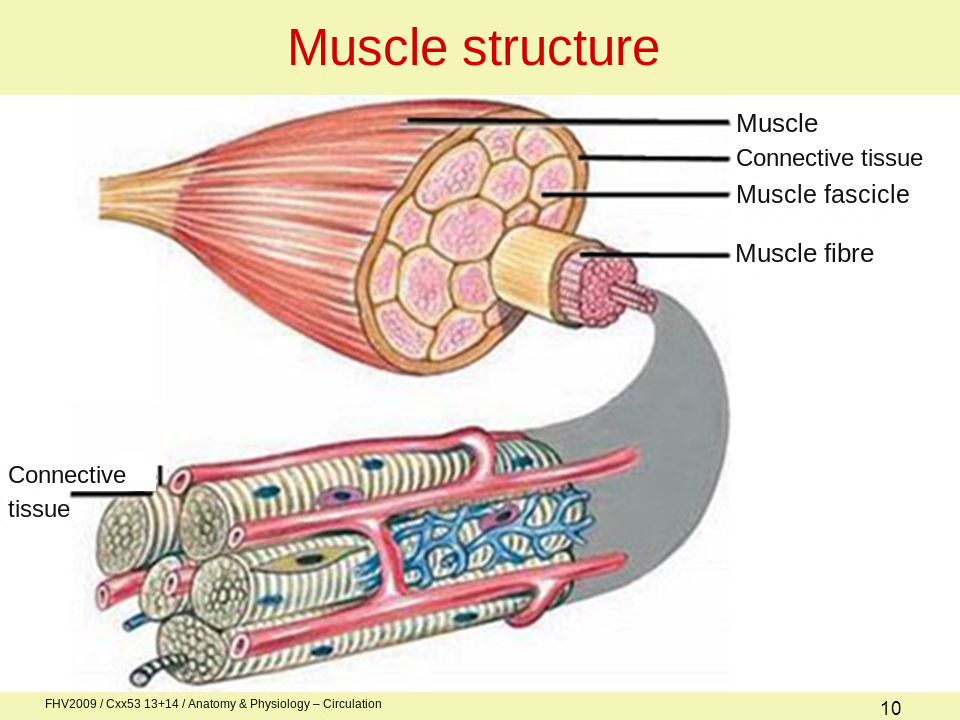
A muscle is not a solid block. You can zoom in from the whole muscle to fascicles, fibres, myofibrils and finally the structures that generate force.
| Level | What is it? |
|---|---|
| Muscle | The whole structure you recognise as, for example, the biceps |
| Fascicle | A group of muscle fibres |
| Muscle fibre | An elongated muscle cell with multiple nuclei |
| Myofibril | A structure inside a muscle fibre containing sarcomeres in series |
| Sarcomere | A unit in which actin and myosin work together |
A muscle fibre therefore does not have just one nucleus. A muscle fibre and a myofibril are also different: myofibrils are located inside the fibre.
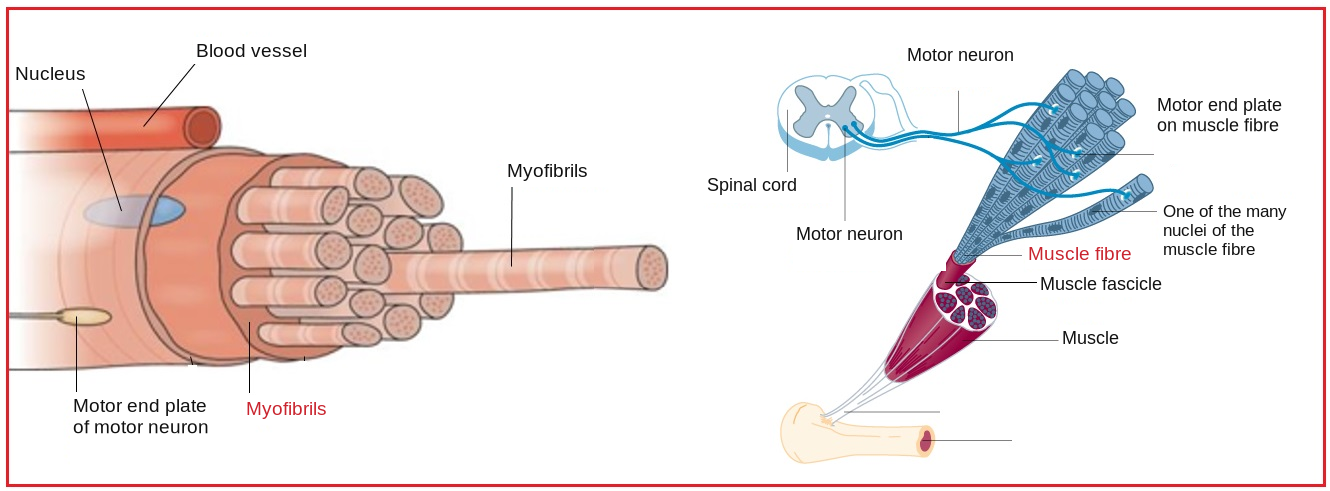
You do not need to memorise these names to train well. They explain why muscle growth involves adaptation within organised tissue, rather than just a muscle temporarily feeling fuller.
How does a muscle contract?
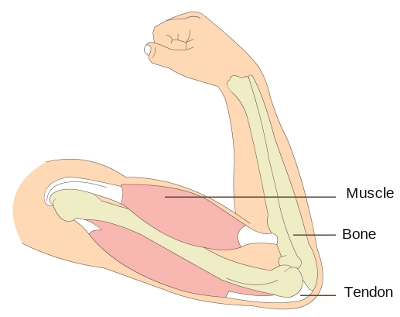
Muscles transmit force to bones through tendons. When you bend your elbow, the elbow flexors help generate force. Each muscle’s contribution depends on the movement and load. The opposing muscle does not have to switch off completely: simultaneous activity can help control the joint.
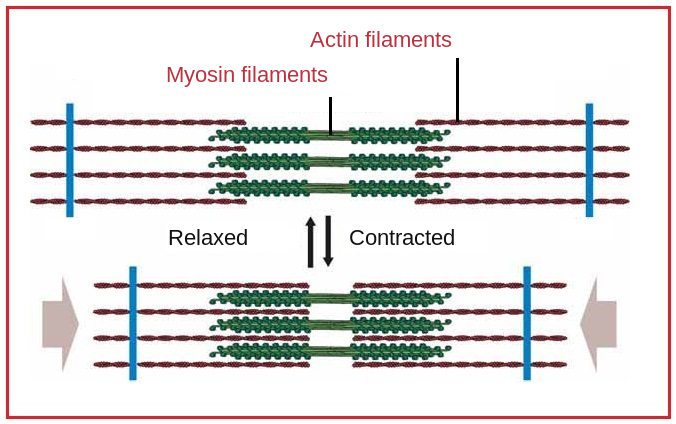
Actin and myosin slide past each other
Within a sarcomere, actin and myosin filaments interact. During shortening, the filaments slide further past each other and their overlap changes. The filaments themselves do not simply become shorter. [10]
A muscle can also produce force while its length stays approximately the same, as when you hold a weight still. During controlled lowering, an active muscle can lengthen. Producing tension therefore does not always mean becoming shorter.
What drives muscle growth: tension or damage?
A muscle can adapt when it is repeatedly loaded sufficiently. Mechanical loading is a key starting point for muscle growth. Consider what your muscles actually have to do during an exercise. Picking up the heaviest dumbbell tells you little if your technique and movement change every time.
Soreness is not a growth score
A new exercise can leave you very sore. That does not prove it builds more muscle than a familiar exercise. Research into the early weeks of resistance training found that high signs of muscle damage did not correspond with later muscle growth. [4]
Avoid chasing maximum damage or pain. Ask whether you can perform the session with control, recover from it and gradually adjust the demands over time.
Read our guide to progressive overload: when to increase weights or repetitions for more detail.
How do you train for hypertrophy?
A useful programme combines consistency, challenging sets and recovery. The 2026 ACSM overview supports progressive resistance training and identifies training volume as relevant to muscle growth. A complicated programme or taking every set to complete failure is not a universal requirement. [2]
| Element | Practical choice |
|---|---|
| Schedule | Choose training days you can usually attend |
| Exercises | Repeat a selection of exercises so you can compare performance |
| Technique | Use controlled movement and a comparable chosen range of motion |
| Effort | Choose a load that makes the final repetitions clearly challenging |
| Progression | Add weight, repetitions or sets when technique and recovery allow |
| Recovery | Consider food, sleep and demands outside the gym |
Do you have to do 8–12 repetitions?
No. This can be a straightforward working range for many exercises, but it is not a magical boundary outside which muscle growth stops. The load, effort, total work and what you can sustain matter too.
For example, start with two or three planned sessions if they fit your week. That is a practical starting point, rather than a prescription for everyone. More days are useful when they make your programme easier to carry out well.
Also read full-body vs split: which structure fits your week? and how to build a strength training plan with sets, rest and recovery.
What is range of motion (ROM)?
Range of motion is the amount of movement at a joint during an action. In a biceps curl, it includes how far the elbow bends and straightens. It is not simply the distance the dumbbell travels through space.
Full ROM uses the chosen complete movement range of the exercise. Partial ROM uses a portion of it. Suitable endpoints depend on your anatomy, the exercise and the load you can tolerate, among other factors.
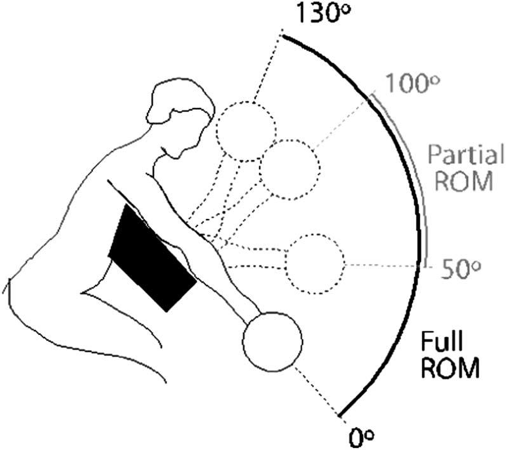
The angles in the illustration are examples. You do not have to force your arm to a particular number to perform a good repetition. Choose a controlled movement you can repeat without pushing into painful positions.
Is full ROM always better for muscle growth?
A generous, controlled and tolerable range of motion is a practical starting point. The research is more nuanced, however, than “full is always good and partial is always wrong”.
Research into muscle length, ROM and exercise selection shows that the portion of the movement matters. Partial repetitions loading a muscle at a longer length can produce muscle growth in certain exercises. Findings depend on the muscle, exercise and resistance across the movement, among other factors. [5]
More stretch does not mean forcing further
Feeling the greatest stretch is not identical to creating the best training stimulus. A lengthened muscle position is no reason to lose control or ignore pain.
For a curl, choose a weight that lets you bend and straighten your elbow steadily. If the movement gets progressively shorter while your whole body swings, reduce the load or end the set. This makes it clearer what you actually achieved.
Does strength training make muscles short or stiff?
Strength training does not automatically make muscles short or stiff. A 2023 meta-analysis found that resistance training can improve range of motion. That does not mean every programme or exercise produces the same change. [6]
The opposite extreme is also inaccurate: muscle structure and architecture are not fixed forever. Your movement range depends on several factors, including joint anatomy, muscle and tendon properties, experience and what a movement currently allows.
Feeling temporarily stiff after a demanding session is different from demonstrating permanently shortened muscles. Using a small ROM also does not automatically reduce flexibility. Look at what you practise and whether your movement options change over time.
If you want to improve a particular position, practise it deliberately and build the demands appropriately. Have persistent pain or a clear limitation assessed rather than repeatedly training harder through it.
What do muscle spindles do?
Muscle spindles are sensory structures within muscles. They provide information about muscle length and changes in length. This feedback helps the nervous system regulate posture, movement and reflexes. [7]
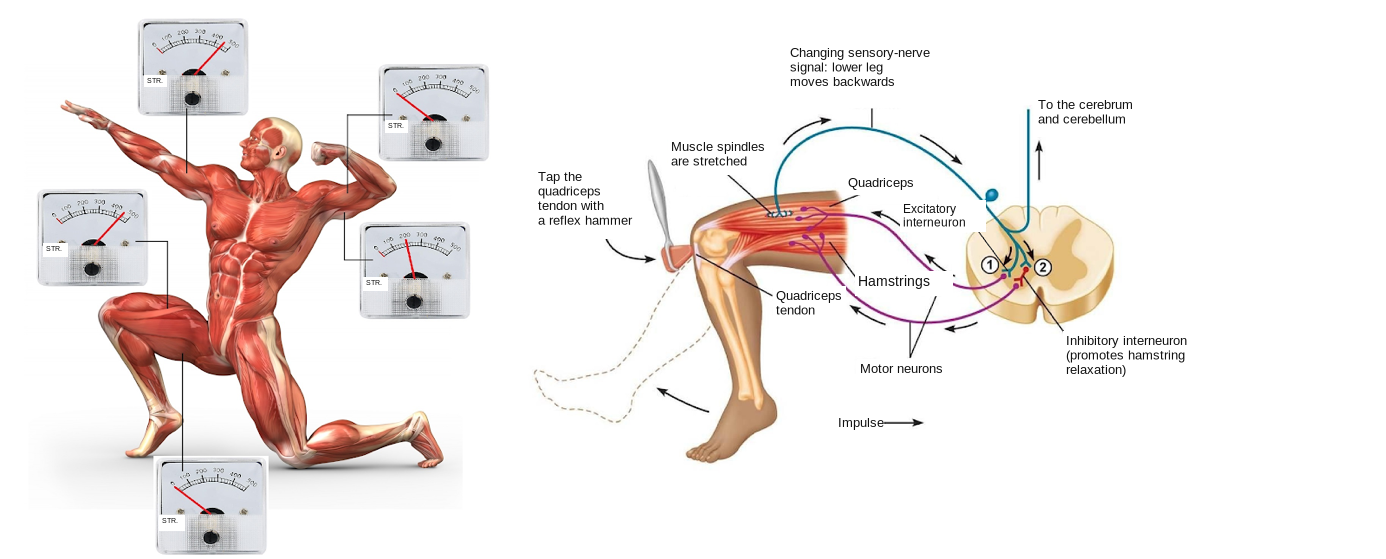
The knee-jerk reflex is a familiar example: tapping the tendon briefly stretches the thigh muscle and can trigger a reflex response. The diagram simplifies a much broader control system.
A spindle is not a sensor that knows your exact safe limit. A reflex or stretching sensation does not, by itself, establish that an exercise cannot cause injury.
What does the Golgi tendon organ do?
A Golgi tendon organ provides information about tension in the muscle–tendon connection. This feedback contributes to the regulation of muscle force.
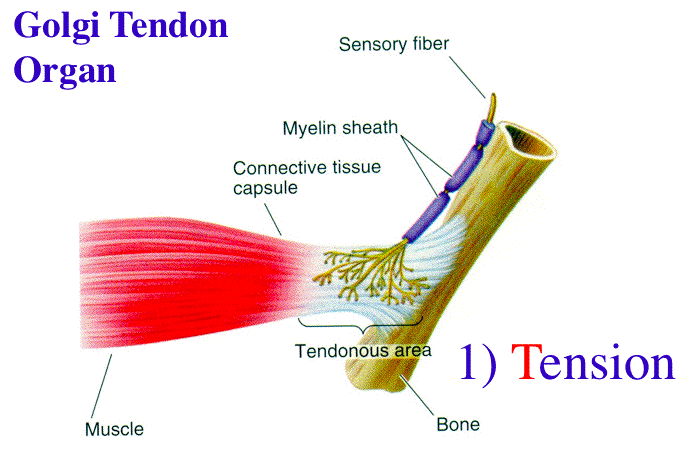
The familiar explanation that excessive tension automatically switches a muscle off to protect you is too simple. Responses depend on the situation; this is not a universal emergency brake. There is also no strong basis for explaining every strength gain as disabling that brake. [8]
The practical point is to avoid relying on an assumed automatic safeguard. Use a manageable load, arrange your equipment appropriately and ask for guidance if you are unsure about technique.
How can you tell whether your training is working?
Use a few consistent reference points. This avoids judging every workout by its pump, soreness or how exhausted you feel.
- Log your training. Record exercises, weights, sets and repetitions.
- Compare the same technique. Note changes in ROM, execution or rest periods.
- Look at a series of sessions. One difficult day does not make your whole programme unsuitable.
- Measure your goal. If you track muscle size, use comparable conditions. Changes immediately after training may be temporary.
- Make targeted adjustments. Check consistency and recovery before changing everything at once.
A simple progression example
You choose three working sets of 8–12 repetitions for an exercise. Across several sessions, you build up controlled repetitions with the same weight. Once you reach the top of the range with the agreed technique, consider a small weight increase.
This illustrates planning; it is not an individual prescription. Our progressive overload guide provides a fuller example and points to consider when increasing the demands.
Frequently asked questions about hypertrophy
What is muscle hypertrophy in one sentence?
Muscle hypertrophy is an increase in the size of existing muscle fibres; in resistance training, it describes the increase in muscle size that develops as tissue adapts to repeated loading.
What is the difference between hypertrophy and strength training?
Hypertrophy is an adaptation in muscle size. Strength training is an activity that can produce that adaptation, among others. You can emphasise muscle growth, maximum strength or a combination in your training.
Do you need soreness for muscle growth?
No. Soreness is neither required nor a reliable muscle-growth score. Assess the quality and progression of your training, recovery and changes over a longer period.
How many repetitions should you do for hypertrophy?
There is no magical number. A range such as 8–12 can be practical, but other ranges can suit your programme too. Load, effort, total work and technique all matter.
Can you get stronger without much muscle growth?
Yes. Improved movement skill and changes in muscle activation can improve performance. A bigger number on the bar therefore does not directly measure how much new muscle you have built.
Should you always train through a full range of motion?
A controlled, tolerable movement range is a useful foundation. Partial repetitions can also be used deliberately. The right choice depends on the exercise, goal and your situation.
Does strength training reduce flexibility?
Not automatically. Resistance training can improve range of motion. Outcomes depend on the programme and movements you practise; temporary stiffness is different from permanently reduced flexibility.
How quickly will you see muscle growth?
This varies with the person, training background, programme and measurement method. Assess several weeks and sessions. A temporary pump, rapid weight fluctuation or one photograph cannot show how much lasting muscle mass you have built.
Build muscle with Aurora Personal Training in Eindhoven
Would you like to turn this explanation into a plan for your own training? At Aurora, we look at exercise selection, technique, training demands and recovery. In our private studio, you receive personal guidance with a programme that suits your experience and available time.
Sources and research
- Roberts et al. (2023) — Mechanisms of mechanical overload-induced skeletal muscle hypertrophy: current understanding and future directions
- ACSM (2026) — Resistance Training Prescription for Muscle Function, Hypertrophy, and Physical Performance in Healthy Adults: An Overview of Reviews
- Škarabot et al. (2021) — The knowns and unknowns of neural adaptations to resistance training
- Damas et al. (2016) — Resistance training-induced changes in integrated myofibrillar protein synthesis are related to hypertrophy only after attenuation of muscle damage
- Review (2026) — The interplay between muscle length, range of motion, and exercise selection: a review
- Alizadeh et al. (2023) — Resistance Training Induces Improvements in Range of Motion: A Systematic Review and Meta-Analysis
- Proske & Gandevia (2012) — The proprioceptive senses: their roles in signaling body shape, body position and movement, and muscle force
- Chalmers (2002) — Do Golgi tendon organs really inhibit muscle activity at high force levels to save muscles from injury, and adapt with strength training?
- Systematic review & meta-analysis — A systematic review and meta-analysis examining if hyperplasia occurs in humans in response to resistance exercise
- NCBI Bookshelf — Actin, Myosin, and Cell Movement