
What makes a good fitness goal?
- Choose one main goal first, so everything is not equally urgent.
- Write down why the goal matters to you.
- Identify the support and resources you need.
- Choose a manageable first step for the coming week.
You do not have to express every ambition in kilograms or centimetres immediately. For a beginner, learning to perform an exercise may be more useful than committing to a fixed performance target.
Outcome goals, performance goals and process goals
| Goal type | Example | What do you track? |
|---|---|---|
| Outcome goal | Change my body composition | A suitable combination of trends and measurements |
| Performance goal | Perform more repetitions of an exercise | Load, repetitions and comparable technique |
| Process goal | Train on Monday and Thursday | Completed sessions and what makes planning easier |
Pair a desired result with a small number of actions. You have more direct control over your behaviour than over how quickly your body changes. Missing a deadline does not automatically mean you have made no progress.
Fitness goals examples: turn an ambition into action
| Your ambition | A useful action | A suitable review |
|---|---|---|
| Exercise more regularly | Plan two manageable training sessions for the next four weeks | Which sessions happened and what got in the way? |
| Get stronger | Record load, repetitions and technique for a chosen exercise | Can I do more across several sessions with comparable technique? |
| Build muscle | Follow my strength programme and record working sets | How are training, recovery and any body measurements developing? |
| Lose weight | Arrange a suitable lunch in advance for busy working days | Is the habit manageable, and does the trend fit my goal? |
| Move with more control | Practise one agreed technique cue during the squat | Can I perform the movement more consistently at the same load? |
| Make training less stressful | Choose two regular sessions and a manageable backup for busy weeks | Does the plan feel workable, and what could be simpler? |
A nutrition goal does not need the same meal frequency, calorie target or protein amount for everyone. Choose an action that addresses your difficulty. If you lack an overview, you might begin by recording what a few ordinary working days look like.
How to set fitness goals in five steps
- Identify your reason. Write down what you would like to notice in everyday life. This clarifies why you want to make time for training.
- Record your starting point. Note your current training routine, experience, available time and any limitations.
- Choose one or two actions. For example, schedule your sessions and agree what to record for each exercise. Make the first step manageable.
- Plan for difficult weeks. Decide whether a shorter session or a different day could work if your usual slot falls through.
- Set a review date. For example, review what worked and which patterns emerged after four weeks. This is a practical check-in, not a deadline for changing your body.
What about SMART fitness goals?
SMART can help you write a clear goal. It is not a complete method for every exerciser. A 2026 expert statement from Exercise and Sports Science Australia cautions against relying on this acronym alone. Experience, preferences and goal type matter. Beginners can also start by exploring what feels enjoyable or manageable. [1] For example: “Over the next few weeks, I will try two different training times and discover which I can maintain.” This may be more useful than imposing a demanding performance target straight away.
Motivation to exercise: why your own reason matters
- Choose goals you personally support.
- Find exercises and an environment where you want to keep learning.
- Discuss doubts with your trainer; a programme is a collaboration.
- Use measurements to inform decisions rather than judge yourself.
A trainer can explain, offer options and adapt the programme. You can describe what is manageable and how the approach feels. That information is as relevant as the numbers in your workout log.
How to track strength training progress
| Session | Exercise | Working sets | Brief note |
|---|---|---|---|
| 1 | Goblet squat | 2 × 8 with 12 kg | Agreed depth; about 3 repetitions in reserve |
| 2 | Goblet squat | 2 × 9 with 12 kg | Same depth; about 3 repetitions in reserve |
| 3 | Goblet squat | 2 × 9 with 12 kg | More controlled execution; load maintained |
In this example, repetitions initially increase. The third session shows that maintaining a performance while concentrating on control can also provide useful information. It is not a required rate of improvement. Compare the same exercise and conditions as closely as possible. More weight through a much shorter movement tells you something different from more weight with the same technique. Read our guide to progressive overload. Strength and muscle growth are related, but getting stronger does not prove an exact increase in muscle size. Technique and neural factors also contribute. Treat strength measurements as one part of your review. [4]
Why beginners and experienced lifters progress differently
What does the first graph show?
The original graph illustrates diminishing returns: the blue progress curve flattens while the green line for programme complexity rises. It is an illustrative model. The month labels are not your personal timeline, the dashed line does not measure your genetic limit, and making a programme more complicated is not a goal in itself.
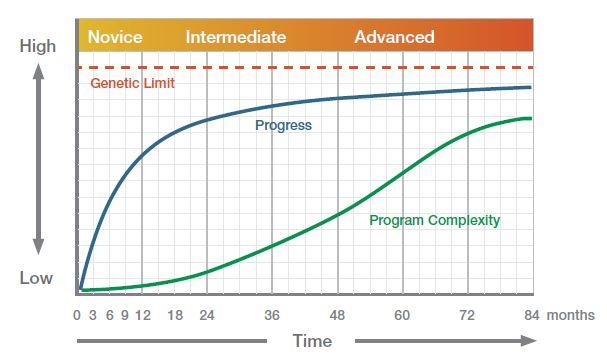
More experience does not mean automatically adding sets or training days every week. First consider whether your current approach still works and what you can recover from. The 2026 ACSM position stand supports progressive resistance training tailored to the desired outcome; greater complexity did not consistently improve results. [3] For a closer look at programme structure, read how to build a strength training plan with sets, rest and recovery.
Why one difficult workout is not automatically a plateau
What does the fitness-fatigue model show?
The second original graph models the relationship between training, fitness, fatigue and performance. Blue represents fitness, green represents fatigue and pink represents performance. These lines are not measured results from an Aurora client. The horizontal axis does not specify a fixed recovery time.
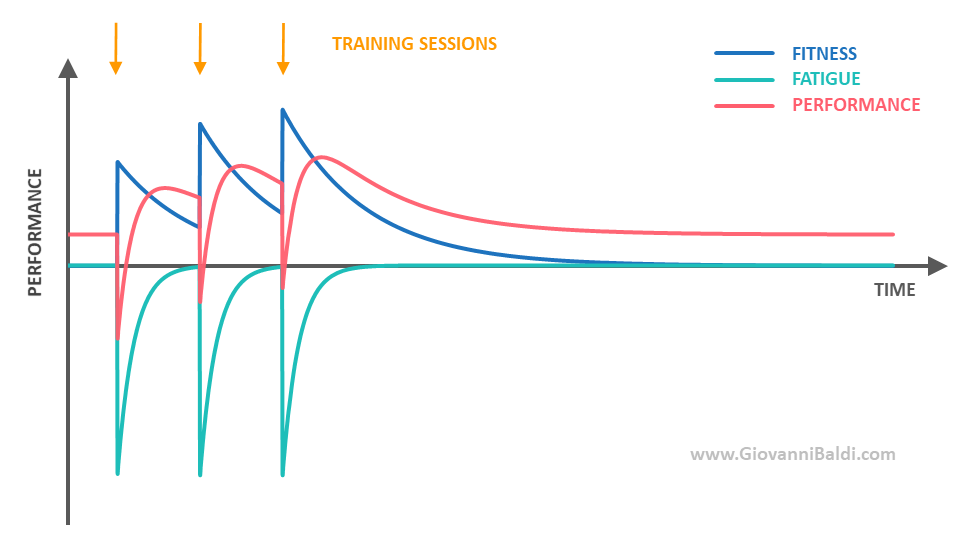
Use the model to understand why one performance is not the whole picture. It does not predict when you should train heavily again. Look at several comparable sessions, your technique and how well you recover. Do not immediately add training when performance disappoints. First check whether you are following the programme as intended and whether the training load still fits the rest of your week.
Which progress measurements fit your fitness goal?
| Method | What can it help with? | What should you consider? |
|---|---|---|
| Workout log | Track performance, technique and consistency | Keep exercise choice, technique and notation comparable |
| Body weight | Follow changes in weight | Fluid and gut contents affect individual readings |
| Photos | Compare visible changes | Same lighting, pose, distance and clothing; only if you want to |
| Circumference | Track change at a defined site | Same site and technique; tension and abdominal contents can vary |
| Skinfolds | Follow repeated skinfold measurements | Skill and a consistent protocol matter; not a flawless body-fat estimate |
| DXA scan | Investigate a specific specialist question | Consider cost, protocol and relevance; not routinely needed to get started |
Body-composition methods have different limitations. A DXA scan is not an infallible referee either. Compare results using the same method and a consistent protocol where possible. Small changes can reflect measurement variation. [5] You do not need to collect as much data as possible. A workout log and a brief conversation about how the plan fits your life may provide enough information for your next decision. For a body assessment, it also matters that you understand the procedure and agree to it. The Australian Institute of Sport emphasises the athlete’s physical and emotional well-being. [6]
How to measure progress without getting lost in numbers
Five questions for your progress review
- Did I manage to carry out the agreed actions?
- Is my exercise technique comparable or more consistent?
- What pattern do I see across several observations?
- How do training, nutrition and recovery fit into my week?
- Which small adjustment could help in the next period?
Avoid changing everything at once. If you continually switch exercises, add sets and overhaul your diet, it becomes harder to understand which adjustment is useful.
Your action plan for the next four weeks
| Field | Write down |
|---|---|
| My main ambition | What would I like to notice in daily life or training? |
| My reason | Why does this matter to me? |
| My starting point | What do I do now, and what fits my experience? |
| My actions | Which one or two actions will I take next week? |
| My schedule | Which days and where? What happens if a session falls through? |
| My log | What will I record for each exercise or habit? |
| My review | When will I look back, and who will I discuss it with? |
If you also outline your training week, specify the exercises, sets, repetitions, rest and agreed effort. Choose movements that fit your goals and abilities. This gives you a clear session to follow and makes it easier for a trainer to review your plan. Unsure how to divide your training days? Compare full-body and split routines. Start with a structure you can repeat and adjust it using what you learn.
Frequently asked questions about fitness goals
What are good fitness goals for beginners?
How do I make an exercise goal specific?
Does every fitness goal need to be SMART?
Should I get stronger in every workout?
Does lifting more weight mean I have built more muscle?
How often should I measure fitness progress?
Can I make progress without daily weighing or photos?
Work on your fitness goals in Eindhoven
Sources and evidence
- Swann et al. (2026) — Goal Setting in Exercise and Physical Activity: An Expert Statement on Behalf of Exercise and Sports Science Australia
- Teixeira et al. (2012) — Exercise, physical activity, and self-determination theory: A systematic review
- Currier et al. / ACSM (2026) — Resistance Training Prescription for Muscle Function, Hypertrophy, and Physical Performance in Healthy Adults: An Overview of Reviews
- Spiering et al. (2023) — Maximizing Strength: The Stimuli and Mediators of Strength Gains and Their Application to Training and Rehabilitation
- Kasper et al. (2021) — Come Back Skinfolds, All Is Forgiven: A Narrative Review of the Efficacy of Common Body Composition Methods in Applied Sports Practice
- Australian Institute of Sport — Best Practice Protocols for DXA assessment of body composition