Why strength can increase without visible muscle growth
You learn to perform an exercise more effectively, and neural control can adapt. You may therefore express greater force in a specific task before seeing an obvious change in muscle size.
This does not make muscle mass irrelevant. Several adaptations can contribute at the same time. A mirror or bathroom scale also cannot identify exactly what has changed within muscle tissue.
A systematic review describes several potential sites of neural adaptation after resistance training. It is not one universal “switch” that changes identically in everyone. See Siddique et al. (2020).
Motor units: recruitment and rate coding
A motor unit consists of a motor neuron and the muscle fibres it controls. Voluntary muscle force depends partly on how many motor units are active and how frequently they discharge.
Recruitment means activating motor units. Rate coding describes the frequency of their action-potential discharges. It is not the speed at which one signal travels along a nerve. See Enoka and Duchateau (2017).
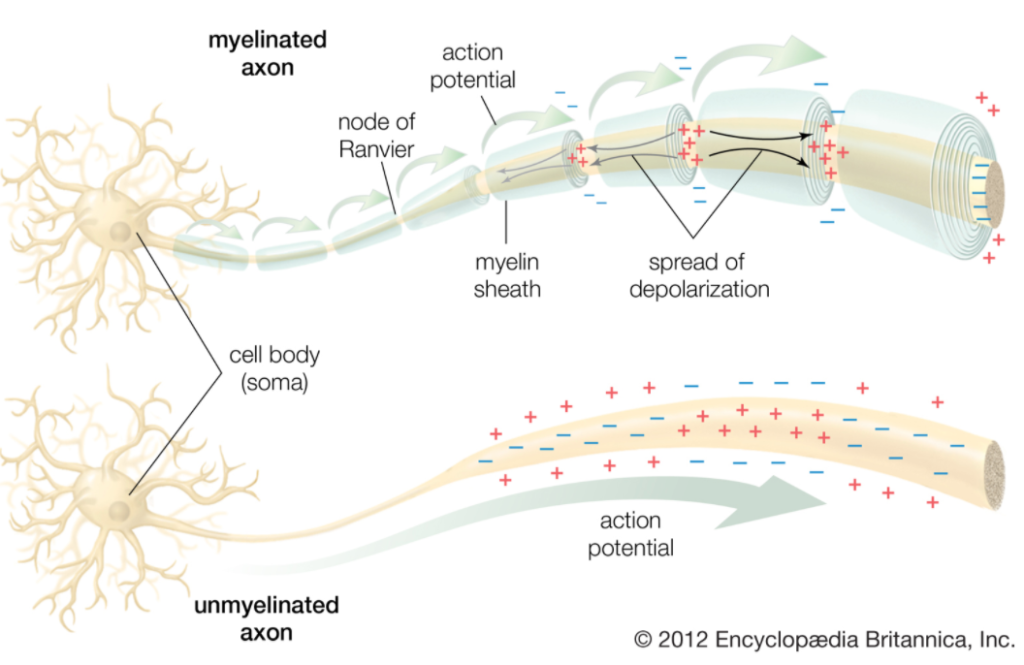
The illustration at the top shows signal conduction in nerve fibres with and without myelin. It illustrates conduction; it does not establish that strength training simply makes your nerves transmit signals faster.
Intramuscular and intermuscular coordination
| Term | Meaning | Example |
|---|---|---|
| Intramuscular coordination | Control within one muscle | Matching motor-unit activity to the force required |
| Intermuscular coordination | Cooperation between different muscles | Coordinating the hip, knee and trunk muscles during a squat |
A compound movement involves more than individually strong muscles. They also need to contribute at suitable times. Timing, stabilisation and an effective movement strategy are part of the skill.
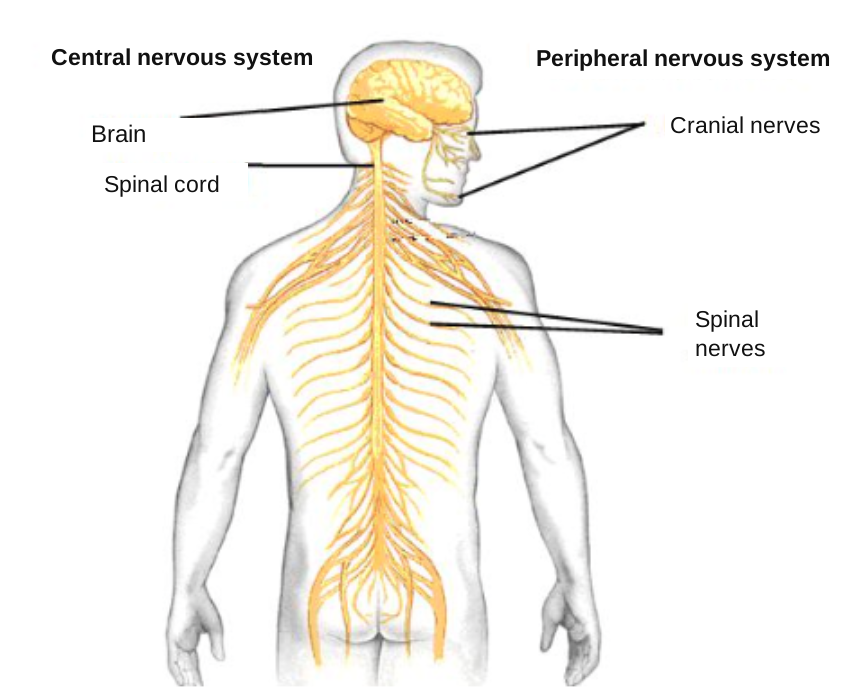
This helps explain the value of practising a movement regularly. The central and peripheral nervous systems participate in this control.
Why you improve most at what you practise
An improved bench press describes a result in that exercise and execution. Transfer to another task can be useful without being complete.
For a pull-up, you can strengthen the relevant muscles and practise the pulling task. Standing up from a chair is a different task and calls for suitable exercise choices.
For context, read what determines muscle strength. For body proportions, read squat technique with long femurs.
How to practise strength as a skill
- Repeat a few useful movements. This lets you compare technique and performance over time.
- Use an appropriate load. Practise against resistance while retaining control of the intended movement.
- Use one clear cue. Select the most useful focus for a set rather than trying to apply five corrections simultaneously.
- Use warm-up sets. Build towards the working load and assess how the exercise feels that day.
- End a set when it stops serving its purpose. Another repetition is not automatically useful if the intended movement is no longer achievable.
- Keep a training log. Record the load, repetitions and execution standard you are trying to repeat.
For example, repeat a goblet squat to a consistent depth with controlled execution. Repetitions may first become more confident; then you build repetitions or load according to the programme. This is an example, not a prediction of how many kilograms you will gain in a particular week.
Use our progressive overload guide to develop the challenge gradually.
Fatigue, focus and confidence
Warming up, concentrating and trusting the task can influence execution. A familiar preparation routine and concrete instructions provide structure. Mental preparation can be relevant without implying that positive thoughts alone create muscle force.
Fatigue can also change execution. Match challenging sets and rest periods to the session’s purpose. Daily maximum attempts are not a prerequisite for learning a movement.
If performance stays below expectations, consider sleep, nutrition and your total workload as well. A disappointing session does not automatically mean your nervous system is “burnt out”.
For a muscle-size goal, read how hypertrophy works. For weekly organisation, compare full-body and split routines.
Frequently asked questions
Can you get stronger without gaining body weight?
Yes, it is possible. Skill and neural adaptation can improve performance without an obvious change on the scale. Body weight alone also does not reveal changes in muscle mass.
Does getting stronger always mean my muscles are growing?
No. Skill, execution, activation and testing conditions also influence performance. Use more than one indicator when assessing muscle growth.
How long do neural adaptations take?
There is no fixed personal timeline. They can contribute early in a training period, but their nature and extent depend on the exercise, experience and programme.
Should every repetition be performed as fast as possible?
The goal determines the approach. Trying to develop force quickly may suit some sessions, but retain control and match execution to load and experience. A heavy repetition may move slowly despite a strong intent to accelerate.
Do I need to take every set to failure?
No. The 2026 ACSM recommendations do not make momentary muscle failure a universal requirement for results. Select an effort level appropriate to your goal and your ability to repeat the programme.
Personal guidance in Eindhoven
Discuss your goals and experience with Roel and explore training that fits your week. Book your free intake.