Book a standalone body fat assessment for €50
Want more insight without starting a personal training programme? Book a standalone assessment at Aurora Personal Training in Eindhoven.
The appointment costs €50 and takes approximately 15 minutes. No training membership is required.
| Included | What you receive |
|---|---|
| Brief introduction | A discussion of your goal and relevant circumstances |
| Skinfold assessment | Measurements taken according to a consistent protocol |
| Weight and body circumferences | Additional information to put your results into context |
| Explanation | A discussion of estimated body fat percentage, fat mass and fat-free mass |
| Short assessment report | Your results, measurement method and assessment date |
| Practical next step | Guidance on what to monitor or adjust |
This appointment is a measurement consultation. It does not include a full training session, a comprehensive nutrition plan or a medical assessment.
Request a standalone assessment and include “standalone body fat measurement” in your message.
What is body fat percentage?
Body fat percentage is the proportion of your body weight that consists of fat.
The related calculations are:
- Estimated fat mass: body weight × body fat percentage ÷ 100.
- Estimated fat-free mass: body weight − estimated fat mass.
For someone weighing 80 kg with an estimated body fat percentage of 20%, this gives 16 kg of fat mass and 64 kg of fat-free mass.
Fat-free mass is not the same as muscle mass. It also includes body water, bones, organs and other non-fat tissue. An increase in calculated fat-free mass therefore does not establish how much muscle tissue you have gained.
Body fat percentage is also not a complete health assessment. Your medical history and other measurements matter too. For example, the Netherlands Nutrition Centre considers BMI and waist circumference together when assessing body weight. [1]
Why measure more than body weight?
Body weight provides useful information, but it does not explain what a change consists of. Fluid, digestive contents and changes in fat or fat-free mass can all affect the number on the scales.
That is why we consider several indicators:
| Indicator | What does it help you monitor? |
|---|---|
| Body weight | Changes in your total body mass |
| Skinfold thicknesses | Changes in subcutaneous fat at the measured sites |
| Estimated body fat percentage | A calculated indication of body composition |
| Waist circumference | Changes in size around your waist |
| Training performance | What you can perform with comparable technique and effort |
| Your experience and recovery | How you feel and whether your approach is manageable |
You can lose fat while your weight remains fairly stable. However, stable body weight alone does not prove that you are simultaneously losing fat and gaining muscle.
How does a skinfold assessment work?
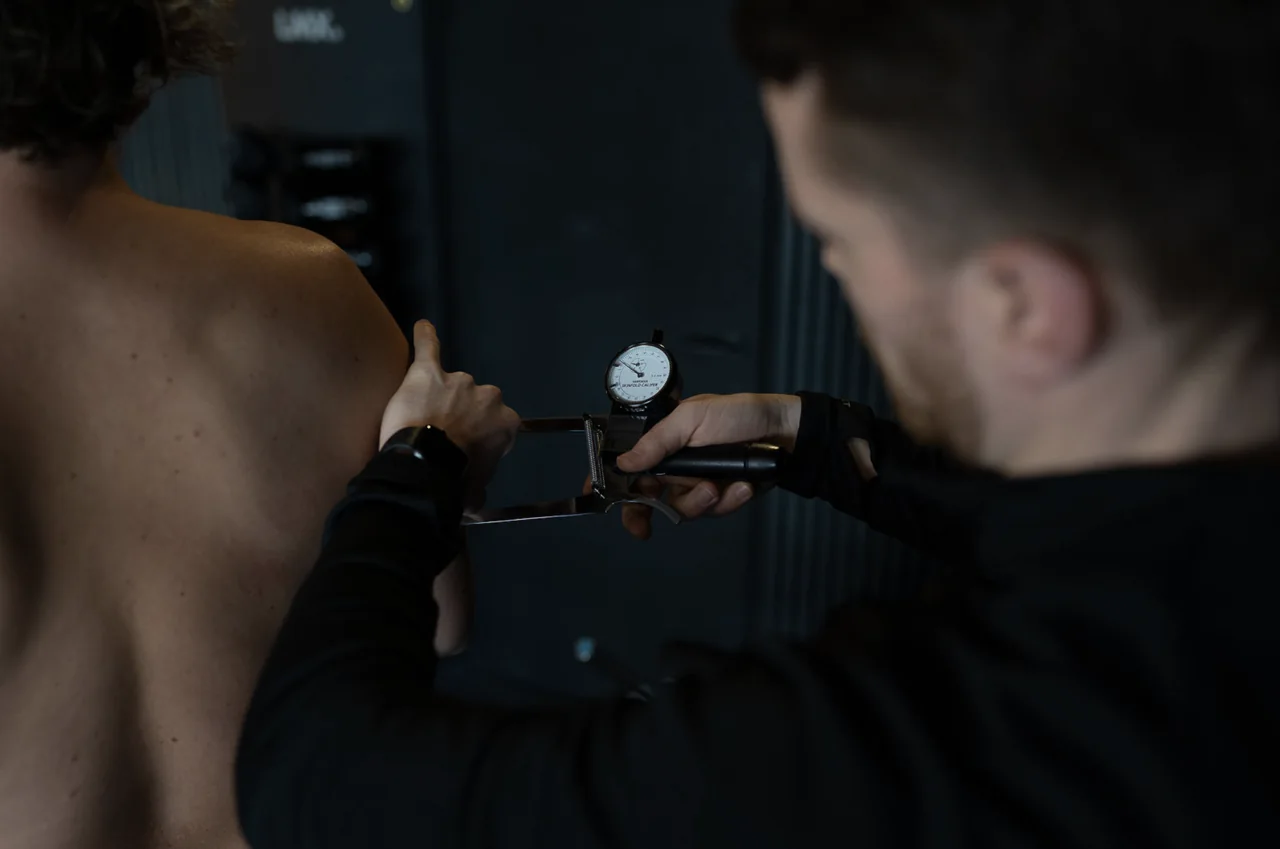
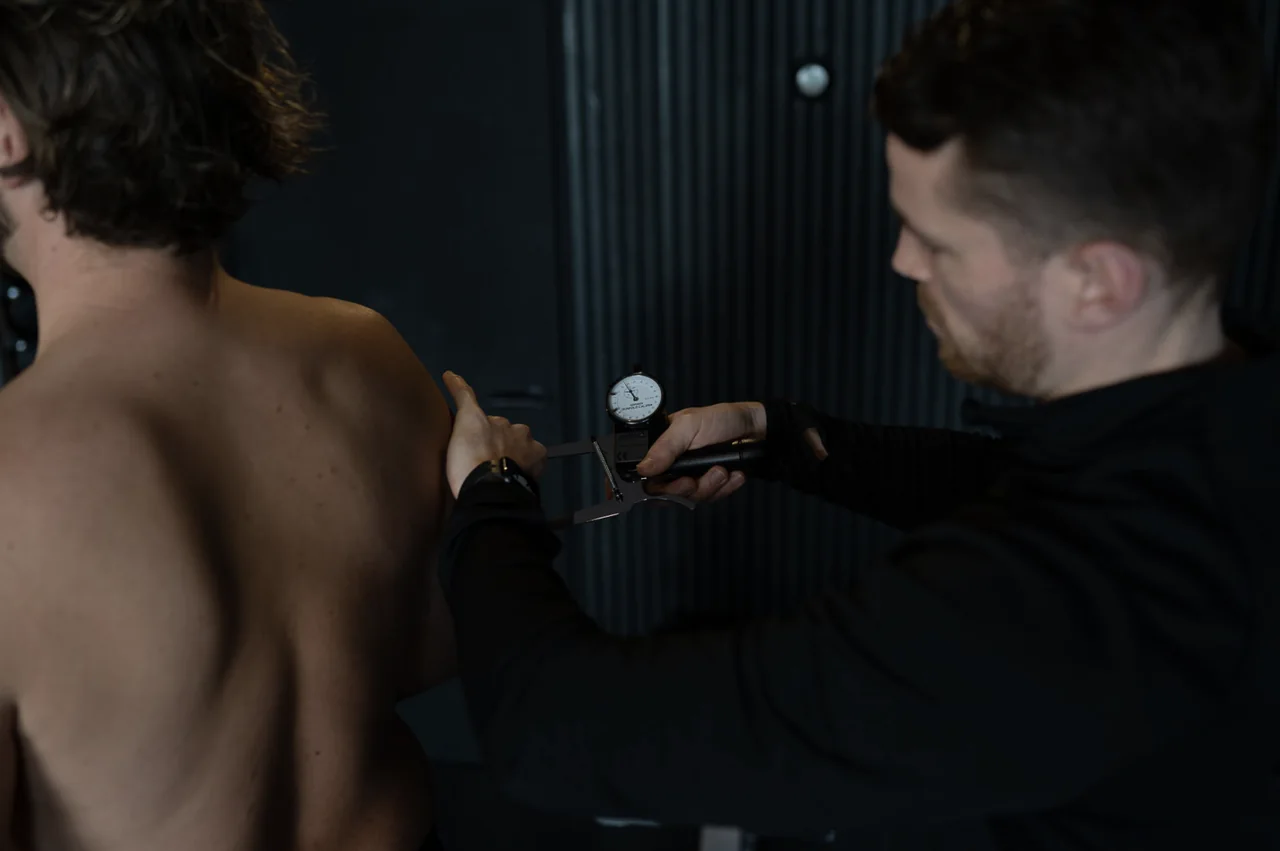
During a skinfold assessment, a fold of skin and underlying subcutaneous fat is gently grasped at specific sites. A skinfold caliper measures its thickness in millimetres.
The measurements can then be used in an appropriate equation to estimate body fat percentage. The measurement sites and the assumptions behind the equation influence the result. [2, 3]
For repeat assessments, consistent technique matters: the same sites, the same method and preferably the same person taking the measurements.
Recording the individual skinfold thicknesses is useful too. This means you are not relying exclusively on the calculated percentage.
A skinfold caliper does not directly measure muscle mass or the fat surrounding your internal organs.
Skinfold Body Fat Calculator
Estimate your body fat percentage using Jackson & Pollock (3 or 7 sites) and the Siri equation.
Enter skinfold thicknesses in millimetres (mm). Preferably take each measurement 2–3 times and use the average.
Result
Formula: Jackson & Pollock (depending on the selected sites) → Siri: body fat % = (495 / BD) − 450.
Measurement sites & tips
- Measure in mm using a caliper. Grasp skin and subcutaneous fat, not muscle.
- Consistency: measure on the same side each time (usually the right), after 3–4 hours without training or a sauna.
- 7 measurement sites: Chest (Pectoral), Mid-axillary, Triceps, Subscapular, Abdomen, Suprailiac, Thigh.
- 3 sites (male): Chest, Abdomen, Thigh. 3 sites (female): Triceps, Suprailiac, Thigh.
Please note: this is an estimate; hydration, technique and population-specific differences influence the result.
How accurate is body fat measurement?
A skinfold assessment is a practical way to monitor changes, but it does not provide an exact body fat percentage.
Skilled technique helps limit measurement errors. Converting the measurements into a percentage remains an estimate.
The result depends on factors including:
- Correct identification of the measurement sites and grasping of the skinfold.
- The assessor’s experience and the measuring instrument.
- The equation used and how appropriate it is for the person being assessed.
The Dutch Association for Sports Medicine guideline emphasises standardised technique and describes limitations in measurement and interpretation. [2]
A small difference between appointments may reflect measurement variation. We therefore avoid drawing major conclusions from a single small fluctuation or claiming one universal margin of error for everyone.
Skinfold assessment, body fat scale or DEXA?
| Method | How does it work? | Important limitation |
|---|---|---|
| Skinfold assessment | Measures skinfold thicknesses; an equation estimates body fat percentage | Technique and equation choice influence the result |
| BIA body fat scale | Uses electrical impedance and calculations to estimate body composition | Conditions, fluid balance and the device influence the result |
| DEXA/DXA | Uses X-ray technology to estimate components including fat, lean soft tissue and bone mineral | It also involves assumptions and requires comparable measurement conditions |
Results from these methods are not automatically interchangeable.
Do not directly compare a reading from your home body fat scale with a skinfold result and assume the entire difference represents fat loss. [4]
For monitoring your own progress, using one method consistently is generally more informative than repeatedly changing devices.
What happens during your assessment at Aurora?
1. We discuss your goal
Do you want to monitor changes during weight loss, review your strength training or establish a starting point?
Your goal determines which information is most useful.
2. We explain the assessment
We explain which sites will be measured and what clothing allows access to them.
Tell us if anything feels uncomfortable. Your comfort and consent come first.
3. We measure and record your results
We record the method used so that future assessments can be compared with it.
Weight and body circumferences provide additional context.
4. We explain what the numbers mean
You receive an explanation of the estimate and its limitations. We then discuss a practical next step that fits your goal.
For training-related questions, we also consider your programme and performance. Read our explanation of progressive overload for more background.
Your body fat percentage does not determine how much weight you should lift in an exercise.
How should you prepare for a skinfold assessment?
The main aim is to make repeat assessments as comparable as possible.
- Book at a similar time of day where practical.
- Avoid arriving immediately after a demanding workout.
- Eat and drink as you normally would; do not try to influence your result by dehydrating yourself.
- Wear clothing that allows access to the measurement sites, such as sports shorts.
- Mention circumstances that might affect comparisons.
- Bring a previous assessment report if you have one.
You do not need to fast for this appointment unless specific instructions have been discussed beforehand.
Discuss unusual circumstances or preparation questions with us before your visit.
How often should you have your body fat measured?
A practical starting point is a repeat assessment after around four to six weeks.
This is a scheduling choice, rather than a compulsory interval or a guarantee that a measurable change will have occurred.
Consider the purpose of the assessment and how long you have followed your training and nutrition approach. Daily body fat checks are unnecessary for this method.
During a personal training programme, periodic assessments may form part of your progress reviews. A standalone assessment is a separate appointment.
Estimate body fat with the skinfold calculator
The calculator on this page provides an estimate based on skinfold measurements.
It uses the selected Jackson–Pollock equation to estimate body density, followed by the Siri equation to estimate body fat percentage.
Only use the measurement sites required by your chosen equation. Three-site and seven-site methods are not lists from which you can randomly select skinfolds.
You need correctly measured thicknesses in millimetres. A calculator cannot correct incorrectly identified measurement sites or an unsuitable equation.
The result remains an estimate. Use the tool to understand your measurements, rather than as a medical diagnosis or proof of precise muscle gain.
Frequently asked questions about body fat measurement in Eindhoven
How much does a standalone body fat assessment at Aurora cost?
The appointment costs €50. It includes skinfold measurements, additional measurements, an explanation, a short assessment report and a practical next step.
Allow approximately 15 minutes.
Can I book an assessment without personal training?
Yes. You can request a standalone assessment without a training membership.
If you would like ongoing coaching afterwards, we can discuss that separately.
Does a skinfold assessment measure muscle mass?
No. It estimates body fat percentage and, when combined with your weight, fat mass and fat-free mass.
Fat-free mass includes more than muscle.
What is a healthy body fat percentage?
There is no single percentage that is the right target for everyone.
Age, physical characteristics, measurement method and health circumstances all matter. Lower is not automatically better.
Medical questions require an appropriate assessment by a healthcare professional.
Why is my result different from my home body fat scale?
The methods use different signals and calculations.
A BIA scale estimates body composition using electrical impedance. A skinfold assessment uses measured skinfold thicknesses.
Focus primarily on comparing repeat assessments using the same method.
Can I make progress without measuring body fat?
Yes. You can also monitor training performance, waist circumference, weight, everyday physical capacity and how you feel.
An assessment is a tool, rather than a requirement.
Is the free intake the same as the standalone assessment?
No. The free intake is intended to discuss your goals and possible training support.
The €50 standalone assessment is a separate consultation with measurements and reporting.
Have your body fat assessed at Aurora in Eindhoven
Would you like a clear starting point or an opportunity to review your progress?
At Aurora Personal Training, we discuss your measurements in the context of your goals and habits.
Appointments take place at our private studio at Vestdijk 159 in Eindhoven.
Request your standalone body fat assessment for €50.
Looking for ongoing support? Explore the 90-Day Personal Training Programme.
Sources
- Netherlands Nutrition Centre: Do I have a healthy weight? Original source in Dutch.
- Dutch Association for Sports Medicine: body composition guideline, skinfold measurement appendix. Original source in Dutch.
- Jackson & Pollock (1978): Generalized equations for predicting body density of men.
- Kasper et al. (2021): uses and limitations of body composition measurement methods in sports practice.