Stretching before or after lifting: what suits your goal?
| Your goal | Practical approach |
|---|---|
| Prepare for strength training | Use active movements and warm-up sets before your working sets. |
| Reach a particular position more comfortably | Try a targeted mobility exercise, then reassess the strength exercise. |
| Improve flexibility | Practise static stretching regularly after training or at a separate time. |
| Finish your session calmly | Include comfortable stretching if you enjoy it. |
| Prevent muscle soreness | Do not rely on stretching: a clear benefit has not been demonstrated. |
Short on time? Prioritise preparation for your first strength exercise. Choose additional stretches for a specific reason rather than automatically stretching your entire body.
What is the difference between static stretching, dynamic stretching and mobility?
Static stretching involves holding a stretch position. One example is a calf stretch in which you keep your heel on the floor and gently lean forwards.
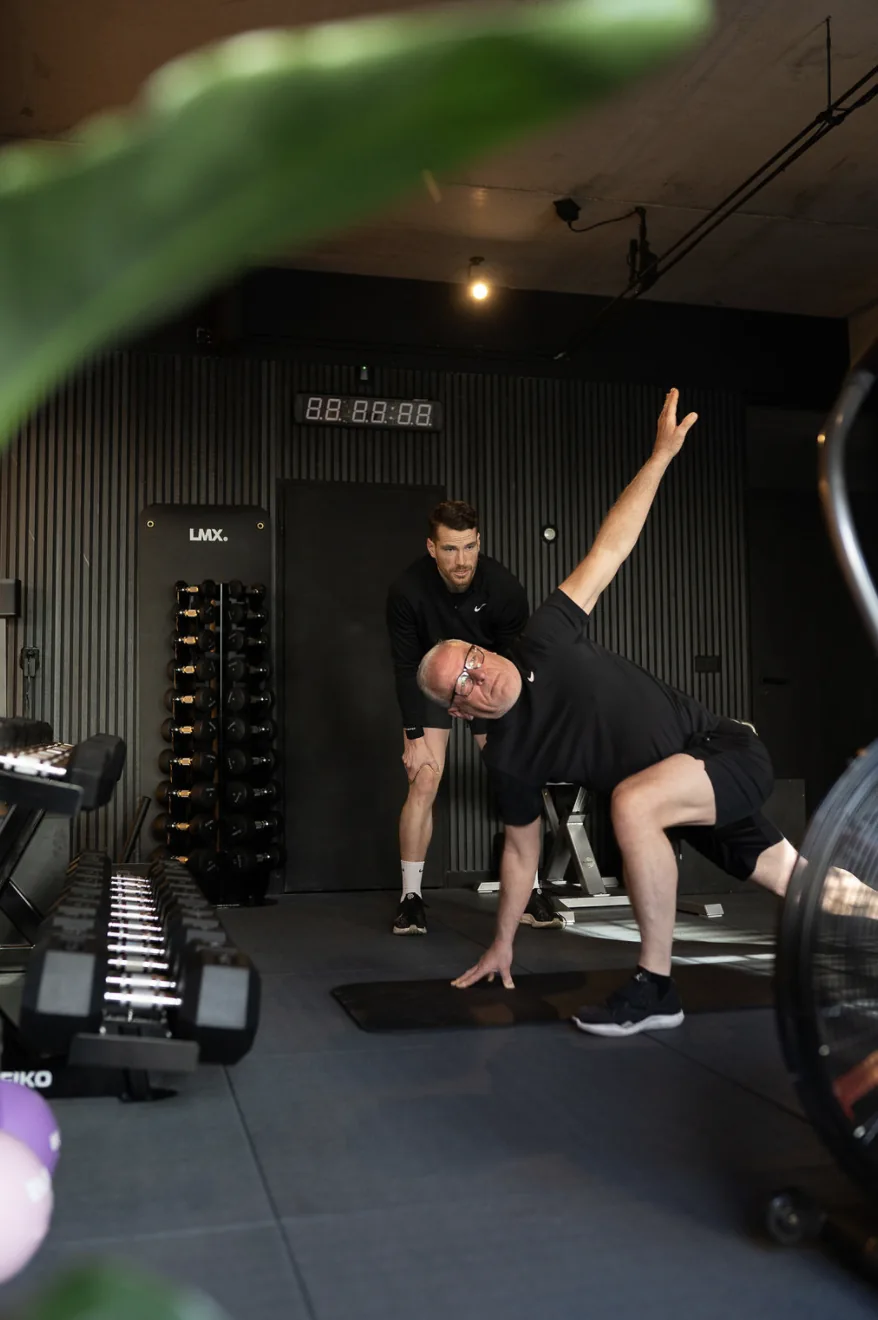
Dynamic stretching involves moving through a controlled range of motion. Examples include gentle leg swings or repeated lunges. You do not hold the end position for a prolonged period.
Flexibility refers to the available range of motion. Here, we use mobility to describe how actively you can use and control that range. Strength and coordination also play a role.
For a squat, for example, you need a range of motion that suits your body proportions, stance and technique. Reaching the deepest possible position is not automatically the best goal.
Read more about mobility in strength training.
Stretching before strength training: when can it help?
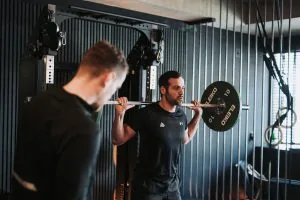
Your warm-up should match the exercises that follow. Before squatting, prepare the squat movement. Before a bench press, build up the pressing movement with lighter sets.
Prolonged static stretching immediately before heavy or explosive exercise can temporarily reduce strength and power. With short stretches included in a complete warm-up, the average effects are much smaller. Stretch duration and the activities performed afterwards make a difference.
A short stretch can therefore have a place when it helps you reach a position you need. Follow it with active movements and lighter warm-up sets, then reassess how the exercise feels.
If your priority is performing as strongly or explosively as possible, save longer flexibility sessions for after strength training or another time.
A practical warm-up for strength training
Use the following structure as a starting point. For a typical workout, you might allow around 6–10 minutes. Heavy working sets or an unfamiliar exercise may require more preparation.
1. Start moving gently
Cycle, row or walk for 2–3 minutes at a comfortable pace. You should still be able to talk easily.
The aim is to ease into movement without tiring yourself out before the workout begins.
2. Choose one or two relevant exercises
Select the examples that fit your session. You do not need to do all of them.
Knee-to-wall ankle mobilisation
Place one foot in front of a wall. Gently move your knee forwards while keeping your heel on the floor.
Perform 6–8 repetitions per side.
Adductor rock-back
Support yourself on your hands and one knee. Extend the other leg out to the side, then gently move your hips backwards and return.
Perform 6–8 repetitions per side.
Upper-back rotation
Start on your hands and knees, with one hand behind your head. Slowly rotate that elbow upwards, then return.
Perform 5–6 repetitions per side.
Wall slide
Stand facing a wall and gently slide your forearms up and down it. Stay within a comfortable range and avoid creating most of the movement by arching your lower back.
Perform 6–8 repetitions.
Before squats, for example, you could try ankle mobilisations. Before a pressing exercise, you might choose upper-back rotations or wall slides.
Check whether the exercise helps: perform a few controlled repetitions of your strength exercise before and after it. Can you reach and control the intended position more easily? If so, you have a practical reason to include that preparation.
3. Build up your first strength exercise
Start with a light weight and increase it in stages towards your working weight. As the weight increases, you can reduce the repetitions to limit fatigue.
Here is an example for someone who already squats comfortably with 60 kg:
| Set | Weight | Repetitions |
|---|---|---|
| First warm-up set | 20 kg | 8 |
| Second warm-up set | 40 kg | 5 |
| Third warm-up set | 50 kg | 3 |
| Working set | 60 kg | Your planned repetitions |
This illustrates the progression; it is not a recommendation to start with these weights.
Choose weights that suit your experience and take enough rest. If another heavy movement appears later in the workout, prepare for that exercise with appropriate lighter sets too.
Stretching after strength training: what does it do?
After your workout, you can use static stretching to work on flexibility or finish in a way you find comfortable. Immediately after your final set is not a compulsory window: a separate stretching session can also work.
Do not expect stretching to provide a proven shortcut to muscle recovery. A systematic review found no convincing advantage of post-exercise stretching over rest for strength recovery or muscle soreness in the following days. The available studies were limited, and the certainty of the evidence was very low.
A stretch may feel pleasant. That feeling alone does not show that your muscles are recovering faster.
Skipping stretching occasionally does not make your strength workout incomplete.
How long and how often should you stretch?
Regular static stretching can improve flexibility. A meta-analysis of 189 studies supports this effect. The most suitable approach does not have to be identical for everyone.
To get started, choose one or two areas where you want to develop more range of motion.
| Element | Practical starting point |
|---|---|
| Duration | 20–30 seconds per stretch |
| Repetitions | Twice per side |
| Frequency | 3 days per week |
| Intensity | A gentle stretch you can comfortably tolerate |
| Timing | After strength training or at a separate time |
This is a practical introductory routine, rather than a proven optimal dose for everyone.
After a few weeks, assess whether the movement you want to improve feels easier, then adjust your approach.
Example: standing calf stretch
Place one leg behind you, keeping the back knee straight and the heel on the floor.
Bend your front knee until you feel a gentle stretch in the calf of your back leg.
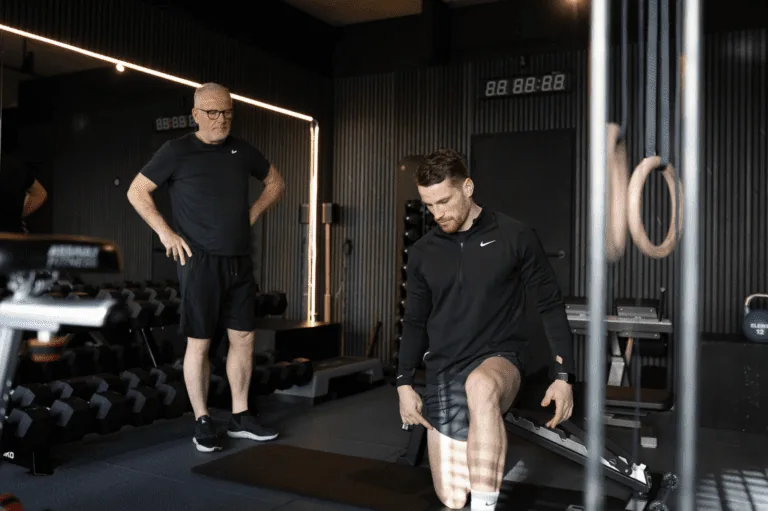
Example: half-kneeling hip-flexor stretch
Place one knee on a soft surface and the opposite foot in front of you.
Keep your torso upright, gently engage the glute on the kneeling side and move your pelvis a small distance forwards. Avoid producing the movement mainly by arching your lower back.
Keep breathing normally. Do not force the end position or try to accelerate progress by stretching harder and harder.
Does strength training make you less flexible?
Strength training does not automatically make you stiff.
A meta-analysis of 55 studies found that training with external resistance can improve range of motion. In comparisons with stretching programmes, there was no statistically significant difference in improvement.
That does not mean every exercise or technique produces the same result. You can work within a range you control and gradually expand it when doing so fits your goal.
Examples include a controlled split squat or Romanian deadlift. Choose an appropriate variation and load: you do not need to force extra depth to make an exercise worthwhile.
Read our guide to progressive overload to learn how to develop your training over time.
Does stretching prevent injuries?
Stretching does not guarantee protection against injury.
A systematic review of sports injury prevention programmes found no clear protective effect from stretching. The sports and programmes studied also cannot be directly translated to your individual strength-training sessions.
Consider your overall training approach instead:
- What load can you currently manage?
- How are you increasing that load?
- How do you respond during and after training?
If a movement is difficult, a different exercise variation, a lighter weight or more practice may be appropriate. Feeling stiff does not, by itself, prove that your muscles have shortened.
Stop a stretch if you experience sharp pain, tingling or numbness. Have persistent or recurring symptoms assessed by a physiotherapist or doctor rather than repeatedly trying to stretch them away.
Frequently asked questions about stretching and strength training
Do you need to stretch before every strength workout?
No. Prepare with relevant active movements and warm-up sets. Add stretches when they support a specific flexibility goal or a position you want to practise.
How long should you hold a stretch?
For a simple flexibility routine, you can start with 20–30 seconds, twice per side.
Adjust the duration and frequency to your goal and response. Preparing for heavy strength training involves different considerations from a separate flexibility session.
Does stretching help with muscle soreness?
Research does not show a convincing benefit of post-exercise stretching for muscle soreness in the following days.
Stretch comfortably if you enjoy it, but do not expect it to prevent soreness.
Can you stretch on a rest day?
Yes. A separate, gentle stretching session can be practical if you want to improve flexibility.
You do not have to attach stretching exercises to every strength workout.
What if you feel stiff after a day at your desk?
Start with gentle movement and see which exercises need attention. Break up sitting with walking or other movement throughout the day.
Then assess whether a targeted exercise helps. If pain persists, seek an assessment of what is causing it.
Strength training and mobility at Aurora Personal Training
Want to understand which preparation suits your body and your training?
At Aurora Personal Training in Eindhoven, we adapt strength training and mobility work to your goals, experience and current capacity.
In our private studio at Vestdijk 159, we look at the movements you want to improve, choose suitable exercises and gradually build up the load. Each exercise has a clear purpose within your programme.
Book a free personal training intake in Eindhoven to discuss your goals and the approach that fits you.
Explore our personal training in Eindhoven.
Scientific references
The studies below support the discussion of performance, recovery, flexibility and injury prevention. The warm-up, example weights and stretching routine are practical illustrations; they were not tested as one complete programme in these studies.
- Chaabene et al. (2019): static stretching and its acute effects on strength and power.
- Afonso et al. (2021): post-exercise stretching, strength recovery and muscle soreness.
- Ingram et al. (2025): static-stretching dosage for flexibility. Published online in November 2024.
- Alizadeh et al. (2023): resistance training and range of motion.
- Lauersen et al. (2014): exercise programmes for preventing sports injuries.