What is explosive strength?
Explosive strength concerns how quickly you can develop force. It matters when pushing off, throwing a ball or accelerating. In a fast task, the amount of force available in time can matter as well as the greatest force you could eventually produce.
People often use explosiveness and power interchangeably in the gym. They are related, but the terms are not identical:
| Term | Meaning | Example |
|---|---|---|
| Maximum strength | The greatest strength performance within a specified task | Performing a heavy squat |
| Explosive strength | How quickly you develop force | Producing force during a brief push-off |
| Velocity | How quickly something moves, with its direction | The movement velocity of a barbell |
| Power | Force and velocity together; in a straight-line task, force in the direction of motion multiplied by speed | Moving a load with both force and speed |
Force is measured in newtons and power in watts. Kinetic energy is another quantity. Holding a load still requires force, while the mechanical power you transfer to that stationary load is zero at that moment. Distinguishing these terms helps clarify the training goal.
What does the force-velocity curve show?
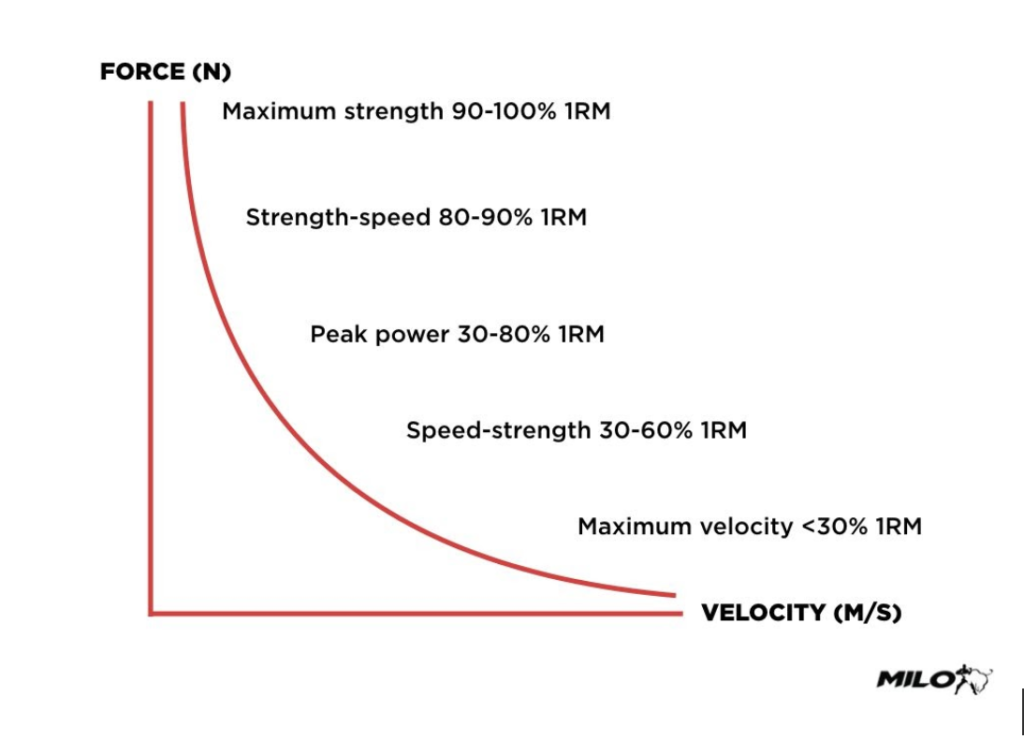
The force-velocity curve describes the relationship between force and movement velocity. During concentric muscle action — when a muscle shortens — high resistance can be associated with slower movement. Lower resistance generally permits greater velocity.
The diagram above is a simplified teaching illustration. It is not an individual assessment or an exact map of every squat, sprint or jump. Multi-joint movements can produce a different relationship from isolated muscles. See the review of force-velocity relationships in multi-joint tasks.
The percentages in the image are not universal boundaries either. Maximum-strength training is not limited to 90–100% of 1RM, and peak power does not occur at the same percentage in every exercise. 1RM means the greatest load you can lift once using the selected execution.
Read the peak power label as a training concept: power requires a combination of force and velocity. It does not mark the point where you automatically produce the greatest force.
From maximum strength to speed: five terms explained
| Term in the diagram | Training emphasis | Practical example |
|---|---|---|
| Maximum strength | Producing a high strength performance | A heavy, controlled squat |
| Strength-speed | Combining relatively high resistance with fast intent | Driving a substantial load upwards |
| Peak power | The highest measured power within the chosen task and measurement method | Testing one exercise at different loads |
| Speed-strength | Rapid force production with relatively little external resistance | Throwing a light medicine ball |
| Maximum velocity | High movement velocity in a specified task | Running at high speed |
These concepts overlap. They help describe training priorities; they are not five compulsory boxes to complete in every session.
Fast movement starts with the right intent
A heavy repetition may move slowly even when you are trying to drive the lifting phase forcefully. Visible speed and intent are different. With a lighter load, the same intent may result in greater movement velocity.
Fast intent does not mean rushing the entire repetition. Establish your starting position, control the lowering phase and accelerate during the part selected for that purpose.
Example: the deadlift
First establish tension through your body and against the bar. Begin from a position you can control, then try to perform the lifting phase forcefully. Do not suddenly jerk the load to make the lift look “explosive”.
Preparation differs in a throwing or jumping exercise. The movement you choose determines how you organise speed, push-off and control.
Exercises for explosive strength training
Select exercises for your experience, goal and the movement you want to improve. These examples are options, rather than a checklist everyone needs to complete.
| Exercise | Training emphasis | Key consideration |
|---|---|---|
| Faster rise from a stable chair | Producing force promptly in a daily task | Establish a controlled rise first; retain balance and lower under control |
| Light goblet squat with a fast lifting phase | Combining resistance and movement speed | Stay in control; jumping is not required |
| Light medicine-ball throw | Producing force quickly and releasing the ball | Use an appropriate space and a safe throwing direction |
| Kettlebell swing | Repeating a rapid hip extension | Learn the hip movement and execution first; avoid turning it into an arm swing |
| Low squat jump | Pushing off and controlling the landing | Use when take-off and landing can be performed consistently |
Olympic weightlifting can also form part of power training. The movements require practice and coaching; you do not have to perform a snatch or clean to develop explosive strength. Cormie and colleagues’ 2011 review explains why the movement pattern, load and velocity should match the intended goal.
How heavy should you train?
The load should let you practise the intended quality. A weight that turns every repetition into a prolonged struggle is usually impractical for fast execution. Exclusively moving very light loads is also incomplete preparation for a maximum-strength task.
The 2026 ACSM recommendations for healthy adults include moderate loads of approximately 30–70% of 1RM and a fast concentric phase for power training. This is an evidence-based general starting point, rather than an individual prescription or the same load for every exercise. Read the ACSM Position Stand.
Jumps, throws and weightlifting variations offer different loading possibilities. You do not need to complete a maximum 1RM test before beginning with a light, controlled variation. A trainer can help select an appropriate starting level.
Why fatigue is not the goal of every set
When repetitions slow noticeably, the task changes. During a set intended to train rapid force production, this can be a reason to stop or rest longer. A burning sensation or breathlessness does not tell you how much mechanical power you are producing.
Research on velocity loss during resistance training shows that fatigue and training outcomes relate to how sets are performed. It does not establish one universal stopping threshold that applies without measurement or context. See the systematic review of velocity loss.
Consider whether you can still approach the intended speed and execution. Training to failure is not automatically necessary. Fatigue itself should not be treated as the sole goal of a muscle-building session either. Read how muscle hypertrophy works.
A practical example within a strength session
For someone who already controls a light goblet squat, a short speed-focused block could look like this. It illustrates the structure and is not a complete individual programme:
- Warm up and practise the chosen squat with controlled repetitions.
- For example, perform 3 sets of 3 light goblet squats with a brisk lifting phase and a controlled return.
- Rest for around 2 minutes between sets, or longer if needed to repeat the intended execution.
- Finish the set when the movement no longer serves its purpose. Avoid adding slow repetitions solely to reach a target number.
- Continue with the planned strength component of the session.
The appropriate load and volume may be higher or lower. Change one feature at a time and reassess quality. This example places the short block early in the session, rather than after a fatiguing circuit.
Include it in a weekly routine you can maintain. Explore how to build a strength-training plan and how progressive overload works.
Does getting stronger automatically make you faster?
Greater maximum strength can provide a useful foundation for power, but it does not automatically make you a better sprinter. You also need to practise the relevant movement, timing and speed.
Sprinting has different demands when accelerating from rest and when running at high speed. These cannot be reduced to one fixed torso angle or one percentage of a squat. A sprint, jump and weightlifting movement are different tasks.
If you spend much of your day sitting and want to build general strength, top running speed may not be your goal. A suitable fast movement can complement strength work, matched to the activities you want to perform in sport or daily life.
How can you track progress?
- Record the exercise, load, sets and repetitions.
- Keep range of motion, starting position and testing conditions comparable.
- Note whether fast execution and control were maintained.
- Use an appropriate test if jumping, throwing or sprinting is your actual goal.
- Assess several sessions and consider recovery.
Video can help you review technique, but it does not provide a reliable exact wattage without an appropriate measurement method. A heavier repetition alone does not prove you have become faster.
For a broader approach, read how to set fitness goals and track progress.
Frequently asked questions about explosive strength training
What is the difference between strength and explosive strength?
Maximum strength concerns the greatest strength performance in a particular task. Explosive strength concerns how quickly you can develop force. A programme can address both.
Should you train light or heavy for explosiveness?
It depends on the exercise and goal. A strength foundation and fast movements can complement each other. No single weight or 1RM percentage applies to every type of explosive training.
Can beginners train explosive strength?
Start with a movement you can control. A faster lifting phase in a light exercise may be more accessible than immediately jumping or using Olympic lifts. Develop complexity and loading gradually.
Should every repetition be as fast as possible?
No. Decide which phase is meant to be fast while retaining the selected technique. Warm-up work, lowering and establishing a controlled starting position may deliberately be slower.
How often should you train explosive strength?
Frequency depends on the overall programme, experience, sport and recovery. A short block within existing strength sessions can be a starting point. More fast sessions are not automatically better.
Is power training the same as training for muscle growth?
No. The goals overlap, but the priorities differ. Power training emphasises force and velocity together. A muscle-building programme also needs to be assessed for its total training work and recovery.
Explosive strength training at Aurora in Eindhoven
At Aurora Personal Training, we begin with the ability you want to develop. Lifting more weight, moving more comfortably and producing force quickly can call for different exercises or priorities. You train with Roel in the private Eindhoven studio, with attention to execution, progression and recovery.
The 90 Day Programme helps you build a training routine around your goals and schedule. During a free intake, you discuss what you want to improve and the support that fits. Book your free intake.
Sources
- ACSM / Currier et al. (2026): strength, power and training prescription in healthy adults
- Cormie, McGuigan and Newton (2011): training considerations for maximal neuromuscular power
- Jaric (2015): force-velocity relationships in multi-joint tasks
- Review (2023): acute and chronic effects of velocity loss during resistance training