Homemade almond butter recipe
| Detail | Information |
|---|---|
| Yield | Approximately one jar |
| Main ingredient | 450 g unsalted almonds |
| Oven temperature | 200°C |
| Brief oven step | 2–3 minutes |
| Processing time | Approximately 10–15 minutes as a guide, depending on your appliance and any necessary breaks |
| Additional oil | 1 tablespoon coconut oil, optional |
| Equipment | Suitable food processor or powerful blender, baking tray, baking paper, spatula and dry glass jar |
Preheating, cooling and any breaks needed for the motor are additional. Total preparation time will therefore vary.
Ingredients
Without the coconut oil, the recipe contains almonds and a pinch of salt. For a version made entirely from almonds, leave out the salt too.
How to make almond butter
1. Preheat the oven
Preheat your oven to 200°C.
2. Spread out the almonds
Line a baking tray with baking paper and spread the 450 g of almonds in an even layer.
3. Warm the almonds briefly
Place the almonds in the oven for 2–3 minutes.
This is the brief oven step from the original recipe. Watch them carefully and remove them before they burn.
They may not become golden brown in this short time. That colour change is not required before continuing.
4. Transfer to your food processor
Place the warm almonds and pinch of salt in a food processor or powerful blender suitable for making nut butter.
Follow your appliance manufacturer’s instructions for warm ingredients and maximum operating time.
5. Process until creamy
Process the almonds into a spread. Allow approximately 10–15 minutes as a guide, depending on your appliance, with breaks as needed.
The almonds will first become crumbs and almond flour, then clump together before developing into a smoother butter.
Switch off the appliance before scraping down the sides with a spatula. Allow the motor to rest as instructed by the manufacturer.
6. Add the optional coconut oil
Using coconut oil? Add the tablespoon and process until evenly incorporated.
If the oil is solid, gently melt it first and allow it to cool sufficiently so it is not hot when added.
7. Transfer to a jar
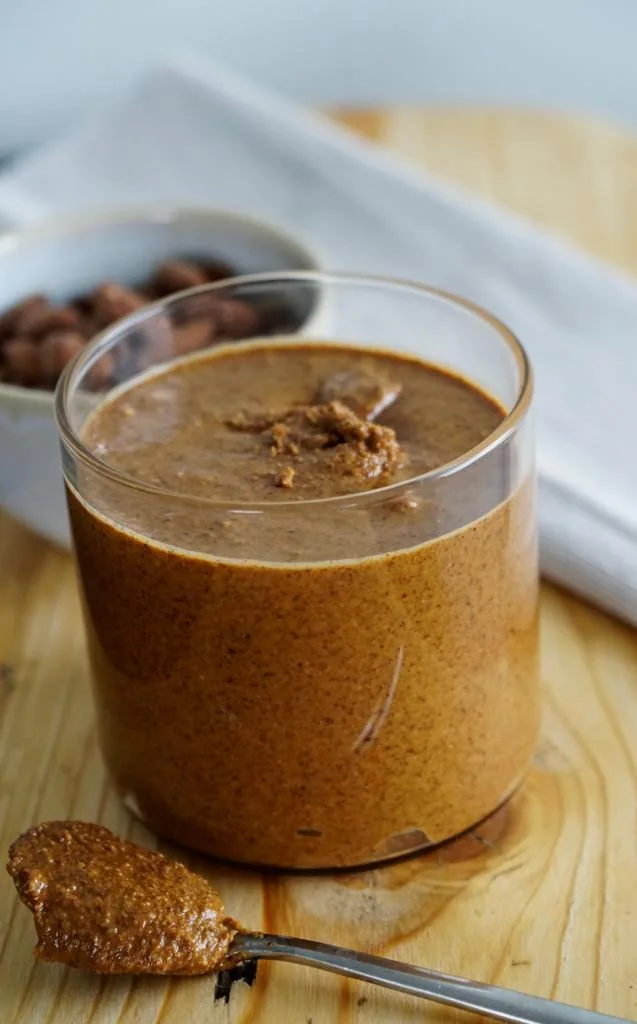
Spoon the almond butter into a clean, completely dry glass jar.
Allow it to cool, close the lid and refrigerate. Always use a clean, dry spoon.
Why do the almonds stay dry and crumbly at first?
A food processor does not produce smooth almond butter immediately.
As the almonds become finer, their oils are released. The mixture usually passes through three stages:
- Crumbs and flour: the almonds break down into small particles.
- A clumpy mixture: the mixture starts sticking together and may collect against the sides.
- Creamy almond butter: further processing makes the mixture smoother.
Do not automatically stop when you see almond flour.
Check that the blades are moving the mixture, switch off before scraping down the sides and give the motor breaks. The time required varies between appliances. [1]
Troubleshooting homemade almond butter
| What happens? | What should you check? |
|---|---|
| The mixture stays like almond flour | Check whether your appliance is suitable and whether you have processed it for long enough |
| Almond butter sticks to the sides | Switch off the machine and scrape the mixture back towards the blades |
| The blades spin beneath the mixture | Check the manufacturer’s minimum batch size and bowl requirements |
| The motor becomes too hot | Stop and let the appliance cool according to its instructions |
| The butter remains very firm | After sufficient processing, decide whether to add the optional coconut oil |
| The butter firms up in the fridge | Allow only the portion you intend to use to soften briefly |
A small smoothie blender is not always suitable for thick nut butter.
Motor power, bowl shape and permitted operating time all influence whether an appliance can handle the recipe.
Can you make almond butter without oil?
Yes. A suitable food processor can release the almonds’ own oils without adding extra oil. Results still depend on your appliance and the almonds you use. The tablespoon of coconut oil therefore remains optional. [1]
Coconut oil can affect the texture, but it is not necessary to make almond butter a nutritious food. It is high in saturated fat and changes the composition compared with almonds alone. [4]
To assess the almond base, try making it without coconut oil first and see how smooth it becomes.
Keep water, milk and other wet ingredients out of the storage jar. If you want to make a sauce, add those ingredients to a separate portion.
Is almond butter healthy?
Almonds provide nutrients including unsaturated fats, fibre and protein.
According to the Netherlands Nutrition Centre, nut butter made entirely from nuts fits within its healthy eating guidelines, the Schijf van Vijf. [2]
The original recipe includes a pinch of salt and optional coconut oil. “100% almonds” only describes the version without either addition.
Almond butter also provides a substantial amount of energy in a small serving. Portion size and the rest of your meal matter.
Enjoy it as a spread or topping without assuming that it automatically improves muscle recovery, causes fat loss or guarantees steady energy levels.
How many calories and how much protein does almond butter contain?
The table below is an illustrative calculation for 20 g of the almond base, without the optional coconut oil.
The figures are calculated from the Netherlands Nutrition Centre’s average nutritional values for unsalted almonds. [3]
| Nutrient | Approximate amount per 20 g almond base |
|---|---|
| Energy | 126 kcal |
| Protein | 4.3 g |
| Fat | 11.2 g |
| Of which saturates | 0.7 g |
| Carbohydrate | 1.4 g |
| Of which sugars | 0.8 g |
| Fibre | 1.4 g |
These are not measured nutritional values for your finished jar.
The almonds used, moisture lost during warming, added oil and portion size can change the figures. The pinch of salt has not been quantified.
For a more accurate calculation, use the product labels and weigh the finished batch.
Containing protein is different from qualifying as “high protein”. That nutrition claim requires at least 20% of the food’s energy to come from protein. The average almond values above do not support that claim. [3, 5]
For more background, read our guide to macronutrients: protein, carbohydrates and fats.
How can you use almond butter?
- On bread: spread a thin layer on wholemeal bread or toast.
- In porridge: stir a small amount into your warm breakfast.
- With quark: add as a topping to quark with fruit and granola.
- On pancakes: serve with protein pancakes.
- With a spiced breakfast: try it as a topping for carrot cake porridge.
Making a dressing with yoghurt or lemon juice? Mix it separately.
A mixture containing wet ingredients has different storage requirements from the almond butter itself.
How to store homemade almond butter
Keep your almond butter in a clean, dry, tightly closed jar in the fridge.
Label it with the preparation date and use a clean, dry spoon each time.
Use approximately two weeks as a cautious practical guideline for this homemade batch, rather than a tested shelf life. Almond freshness, hygiene and any additions affect how long it keeps.
Make smaller batches if you use it infrequently.
Refrigeration can make the butter firmer, particularly when coconut oil is included. Spoon the amount you need into a separate dish and let that portion soften briefly.
A layer of separated oil can occur naturally. Stir it back in with a clean spoon.
Discard the almond butter if you notice mould, an unusual smell or a rancid taste. An oily layer alone does not establish that it has spoiled.
Frequently asked questions about making almond butter
Is almond butter the same as almond paste?
No. In English, almond butter usually means a spread made from ground almonds.
Almond paste usually refers to a sweet baking ingredient. This recipe makes almond butter, not a sweet almond filling.
Do you need to soak the almonds first?
No. The original recipe uses dry almonds.
Soaking changes their moisture content and the preparation process. For this recipe, use dry ingredients and the brief oven step described above.
Can you make almond butter without a food processor?
A powerful blender may work if the manufacturer states that it is suitable for making nut butter.
A hand blender or small smoothie blender will not necessarily produce the same result. Check the instructions and the batch size required for the container.
Is this almond butter sugar-free?
No sugar is added to the recipe, but almonds contain naturally occurring sugars.
“No added sugar” therefore means something different from “sugar-free”.
If you later add honey or syrup, “no added sugar” no longer describes that version. [3, 5]
Is this recipe vegan, lactose-free and gluten-free?
The listed ingredients are plant-based and contain no milk ingredients.
For specific dietary requirements, choose suitable products and check labels and possible cross-contamination.
The recipe contains almonds, a tree-nut allergen.
Is homemade almond butter cheaper?
That depends on the price of your almonds and the shop-bought product you compare it with.
Add up the cost of 450 g of almonds and any oil, then compare the price per 100 g.
Making it yourself gives you control over the ingredients, but savings are not guaranteed.
Nutrition that fits your daily routine
Want to understand how breakfast, snacks and training can work together?
At Aurora Personal Training in Eindhoven, we help you build practical eating habits that fit your goals and schedule.
Book a free intake at Aurora Personal Training to discuss an approach that suits you.
Sources for the additional guidance
- Love and Lemons: processing almond butter, blending stages and motor breaks. This source supports the processing guidance; the Aurora recipe retains its own quantities and brief oven step.
- Netherlands Nutrition Centre: nuts and 100% nut butter.
- Netherlands Nutrition Centre: average nutritional values for unsalted almonds.
- Netherlands Nutrition Centre: coconut oil and saturated fat.
- Netherlands Nutrition Centre: conditions for nutrition claims.
The Netherlands Nutrition Centre sources are in Dutch.